
Summary
Editor's rating
Is the 5‑camera kit and subscription actually worth it?
Simple, plastic, and built more for practicality than style
Battery life claims vs what actually happens
Weather, disconnects, and how stable the system feels
Motion detection, video quality, and app behavior in real life
What you actually get and how it all fits together
Pros
- Easy, quick setup with five cameras and one sync module covering a whole house
- Strong battery life with AA lithiums and options to tweak settings to save power
- Decent 1080p video, wide field of view, and useful person detection with subscription
Cons
- Sync Module Core has no local storage; subscription or upgraded module is basically required
- Motion detection and person detection can occasionally miss events or mislabel movement
- Small delay on live view and occasional connectivity quirks depending on Wi‑Fi quality

Specifications
View full product page →| Brand | Blink |
A wireless camera kit that doesn’t need drilling or a PhD
I picked up the Blink Outdoor 4 five‑camera kit because I wanted to cover a whole house without running cables or paying for some fancy wired system. I’ve used a couple of other brands before (including a cellular camera with a solar panel), and they all ended up either dropping connection all the time or costing way too much in subscriptions and accessories. So I went into this with pretty realistic expectations: if it stayed online, caught motion reliably, and didn’t chew through batteries in a month, I’d call that a win.
Setup was honestly straightforward. You get five cameras, the Sync Module Core, batteries, mounts, and the USB‑C cable with power brick for the module. I had the app installed, scanned the QR codes, joined my Wi‑Fi, and had the first camera live in under 10 minutes. Adding the other four took maybe another 20–25 minutes while I walked around deciding where to stick them. I didn’t have to touch my router settings, but you do want a decent 2.4 GHz signal where you’re installing them.
After a couple of weeks, the main thing that stood out is that this system is clearly built around convenience and low power. You can tell Blink is trying to squeeze battery life by limiting how long each clip records and how often the camera wakes up. If you’re expecting 24/7 recording like a wired NVR system, this is not it. It’s more of a "motion clip + live view when you ask" type of setup. For general home monitoring, deliveries, and checking the driveway or backyard, that’s fine. For detailed security logs, it can feel a bit light.
Overall, my first impression is that it’s a pretty solid, no‑drama solution for people who want easy wireless coverage and are okay with a subscription for cloud storage. It’s not perfect: motion can miss things sometimes, person detection isn’t magic, and there’s always a small delay when you open live view. But compared to the headache and cost of the solar/cellular setup I used before, this feels a lot more practical for a normal house.
Is the 5‑camera kit and subscription actually worth it?
Value is where this Blink setup makes more sense than some of the alternatives I’ve tried. When you look at what I previously paid for a cellular camera with a solar panel, spare proprietary battery, charger, and the required cellular + cloud plan, I was basically dropping around $500 up front and $300 a year in ongoing costs. With Blink, the hardware cost for five cameras plus the Sync Module Core is a lot more reasonable, especially if you catch it on sale. The ongoing subscription for cloud storage is around the price of a streaming service, not a car payment.
The catch is that the Sync Module Core doesn’t support local storage, so if you hate subscriptions on principle, this bundle isn’t ideal. You either accept the cloud plan after the 30‑day trial, or you spend extra on a Sync Module 2 or XR plus USB/microSD for local backup. Personally, I think paying for the unlimited Blink plan for a whole house full of cameras is acceptable, but it would have been nicer if the core module at least had a basic local option from the start.
In terms of what you get for the money: setup is easy, coverage is good with five cameras, battery life is strong, and the app is simple enough for non‑techy people to use. You also get Alexa integration, which is handy if you already have Echo devices. On the flip side, you’re not getting ultra‑high‑resolution video, 24/7 continuous recording, or bulletproof motion detection. This is a budget‑friendly, practical system, not a professional‑grade surveillance setup.
So, is it good value? I’d say yes, for typical homeowners or renters who want to see who’s at the door, watch deliveries, and keep an eye on the yard without running wires. If you’re extremely picky about never missing a single movement or you need forensic‑level video quality, you’ll probably need to spend quite a bit more on a different type of system. For everyday peace of mind at a reasonable ongoing cost, this Blink kit lands in a pretty solid spot.
Simple, plastic, and built more for practicality than style
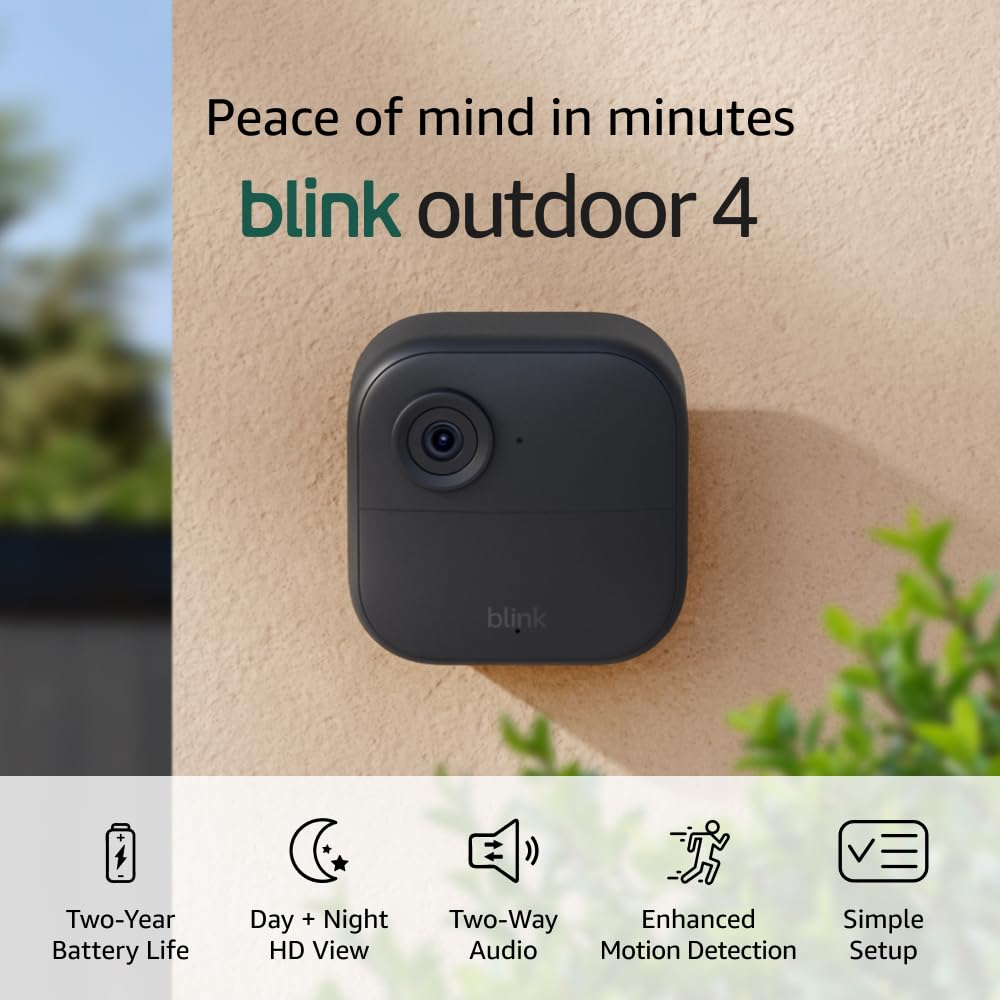
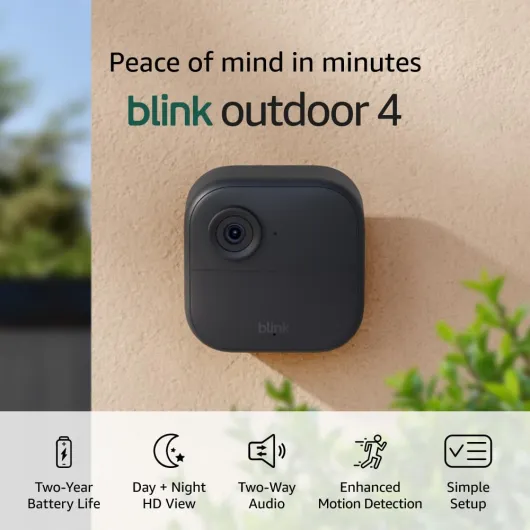
The design is very no‑nonsense. Each Blink Outdoor 4 is a small black square with rounded corners and a single lens and LED on the front. No fancy metal trim or flashy branding. If you’re looking for something that doubles as a decorative piece, this isn’t it. But if you just want something that doesn’t draw much attention and can tuck under a soffit or next to a door, it does the job.
The mount design is actually better than some older Blink versions. Instead of the cone‑shaped mount that was annoying to aim, this one has a flat base style that screws into the wall or soffit, and the camera snaps on. Adjusting the angle is straightforward, and it holds its position decently even outdoors. One of my cameras is paired with a battery expansion pack (sold separately), which makes it noticeably heavier, but the mount still holds without drooping. It’s not pretty, but it’s functional.
The casing is plastic, as you’d expect at this price. It’s rated for outdoor use and the operating temperature range is -4 to 113°F. I’ve had it through rain and some cold nights, and nothing has fogged up or cracked. You do want to be a bit careful when opening the back to change batteries; the clip feels like it could eventually wear out if you’re too rough. Still, given the cameras are meant to sit for long stretches without being touched, I’m not too worried.
On the downside, the all‑black, glossy-ish front picks up dust and water spots pretty quickly. After a few days of rain and wind, the lens area can get a light film that slightly softens the image at night, especially with IR on. Wiping it down every so often fixes it, but it’s one more small maintenance thing. Overall, the design is basic but practical: easy to mount, easy to aim, and low‑profile enough that most visitors won’t stare at it, which is all I really needed.
Battery life claims vs what actually happens
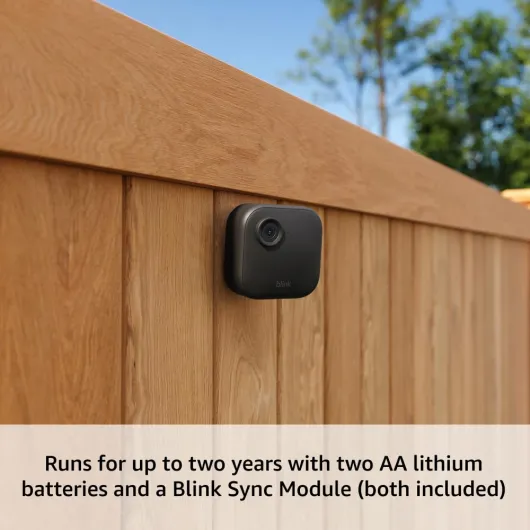
Blink advertises up to two years of battery life on two AA lithium batteries per camera, which sounds huge. In reality, it depends heavily on how you use the cameras. If you leave everything on default, don’t hammer live view, and your motion activity is moderate, I can see them lasting a year or more pretty easily. If you have a busy street, lots of motion events, long clip lengths, and high video quality, that two‑year claim drops fast.
In my case, with five cameras installed, I set them up like this: front door and driveway on higher sensitivity and normal clip length, backyard and side yard a bit lower, and one camera with the person detection feature turned on. After a couple of weeks of daily use (including some testing and playing with live view more than I normally would), the battery indicators barely moved. Other long‑term users report they’re still going strong months in, even with decent traffic. That lines up with the idea that the cameras are pretty conservative with power when idle.
There are some trade‑offs though. To save battery, the cameras don’t constantly stream. They wake up when there’s motion or you request live view. That’s why you get a short delay connecting, and why you might miss the first second or so of motion if someone sprints through the frame. You can tweak settings like clip length, retrigger time, and video quality to balance how much you capture versus how much battery you use. Shorter clips and longer retrigger time mean fewer events and longer life.
If you’re really paranoid about battery swaps, Blink sells a battery expansion pack for the Outdoor 4 that uses four AA batteries and leaves the internal slots empty. It makes the camera bulkier and heavier, but it should stretch the time between changes even more. Personally, I’d rather just stick with the regular two batteries and swap them once a year or so, but it’s an option. Overall, the battery performance is one of the strong points here: as long as you’re not abusing live view all day, you won’t be climbing a ladder every month to replace batteries.
Weather, disconnects, and how stable the system feels
From a durability and stability angle, the Blink Outdoor 4 feels decent for a consumer‑grade wireless system. The cameras are built to handle typical outdoor conditions, and the operating range of -4 to 113°F covers most people’s climate. I’ve had them in rain, wind, and chilly nights, and nothing has leaked or glitched in a big way. The plastic doesn’t feel premium, but it doesn’t feel flimsy either. Once they’re mounted, you basically forget about them except for the occasional lens wipe.
Where durability gets a bit more interesting is on the software and connectivity side. Every now and then, a camera might go offline or become unresponsive. In my experience, and from what other buyers report, this is usually tied to firmware updates or network hiccups rather than the hardware failing. Pulling the batteries and putting them back in, or power‑cycling the sync module, usually brings things back. It’s not ideal, but it’s also not some constant daily problem. I’d call it occasional annoyance level rather than deal‑breaker.
One thing to keep in mind is that your network quality matters a lot. If your router is buried behind a TV, stuck in a closet, or if your upload speeds are weak, you’ll see more lag and more random disconnects. When I moved my router higher and made sure the sync module was in a central spot, the whole system behaved better. Some people may need a Wi‑Fi extender or the newer Sync Module XR for longer distances, especially if you’re trying to cover a gate or detached garage a few hundred feet away.
Long term, I’d say the system feels stable enough for home use. It’s not enterprise‑level reliable, and you may see the odd missed recording or late notification, but nothing that screams “junk”. The main wear point will probably be the battery door and the mounts if you’re constantly re‑aiming or swapping locations. For a set‑and‑forget wireless system, though, the durability is pretty solid for the price range.
Motion detection, video quality, and app behavior in real life
Performance is where you really feel what this system is meant for. The video quality is decent for 1080p. During the day, faces, license plates at close range, and small details like packages on the porch are clear enough. At night, with infrared on, you lose some sharpness and color (obviously), but for seeing who is walking up to your door or if an animal is in the yard, it’s fine. If you add some external lighting (like solar floodlights), the camera looks noticeably better at night and doesn’t rely as much on the IR.
Motion detection is mixed but usable. You can set sensitivity (1–9), choose motion zones, and pick between “All Motion” and “Person Detection” if you’re on the subscription. All Motion catches pretty much everything: people, cars, animals, shadows, tree branches on windy days. It can get spammy. Person Detection cuts down a lot of that noise, but it’s not perfect. I’ve seen it miss slow movement at the edge of the frame, and a couple of times it tagged a deer as a person. Also, there are occasional alerts where the app says there was motion but no clip gets saved, which is irritating if you’re trying to review something specific.
Latency is another point. Because these are battery‑powered and wake on motion or on request, live view always has a small delay. From tapping a camera in the app to actually seeing video, it’s usually a few seconds. When streaming through an Echo Show, you feel that delay a bit more, but it’s still acceptable for checking what’s happening outside. The important thing is that the recording itself lines up with real time, so the delay doesn’t affect what gets captured, just how quickly you can watch it live.
On the connectivity side, if your Wi‑Fi is solid and the sync module is placed sensibly (not buried behind a TV or in a closet), the cameras stay online. When people complain about disconnects, it usually comes down to weak signal or a router in a bad spot. I tested one camera a good 300–350 feet away with a Wi‑Fi extender helping the signal, and it stayed responsive. Overall, performance is good enough for normal home use, but if you’re expecting perfect detection range and zero missed events, you’ll probably be a bit frustrated now and then.

What you actually get and how it all fits together
The kit is pretty complete out of the box. You get five Outdoor 4 cameras, one Sync Module Core, ten AA lithium batteries (Energizer), five basic mounting kits, and a USB‑C cable with power adapter for the module. No memory card or USB drive, because the Core module doesn’t support local storage at all. If you want local backup, you’d have to buy a Sync Module 2 or the new XR plus a USB drive or microSD card separately, which is a bit annoying given the price of a five‑camera bundle.
Each camera is small and light, about 2.8 x 2.8 x 1.6 inches and around 140 g. They’re all black, so they blend okay on darker siding or under eaves, but they stand out a bit on white walls. The field of view is listed as 143° diagonal, and in practice it does feel wide. When I compared it to an older Ring cam I had lying around, the Blink clearly showed more of the driveway and yard in one shot, but it also made distances look longer than they are, which can make people look further away than they actually are.
In terms of features, the key ones you’ll actually use are:
- 1080p daytime video and infrared night vision
- Two‑way audio (talk through the app)
- Motion detection with activity zones and sensitivity settings
- Person detection if you pay for a Blink subscription
- Alexa support for live view and voice control
The catch is the cloud piece. Out of the box, you get a 30‑day free Blink subscription trial. After that, if you want clips stored in the cloud, you’re looking at a monthly fee (roughly the $3.99 single‑cam or $11.99 unlimited setup). Without it, the Sync Module Core doesn’t give you local storage, so you’re basically using it just for live view and notifications unless you upgrade the module. That’s the part that feels a bit like they’re nudging you pretty hard toward the subscription.
So in short: the kit gives you everything to get up and running, and the system is easy to understand, but if you’re hoping for an all‑in‑one solution with local storage included, that’s not what this bundle is. It’s more of a starter platform that becomes complete only once you add a subscription or a different sync module.
Pros
- Easy, quick setup with five cameras and one sync module covering a whole house
- Strong battery life with AA lithiums and options to tweak settings to save power
- Decent 1080p video, wide field of view, and useful person detection with subscription
Cons
- Sync Module Core has no local storage; subscription or upgraded module is basically required
- Motion detection and person detection can occasionally miss events or mislabel movement
- Small delay on live view and occasional connectivity quirks depending on Wi‑Fi quality
Conclusion
Editor's rating
The Blink Outdoor 4 five‑camera system is a straightforward wireless setup that covers a lot of ground without much hassle. It nails the basics: easy installation, decent 1080p video, usable night vision, and genuinely good battery life if you don’t abuse live view. Motion detection and person detection are good enough for everyday home use, even if they occasionally miss an event or mislabel an animal. The app is simple, and Alexa support is a nice bonus if you already live in that ecosystem.
The main downsides are tied to the business model and some technical limits. The included Sync Module Core doesn’t handle local storage, so if you want to keep recordings after the free trial, you’re basically pushed into a subscription or into buying a different sync module. There’s also the usual wireless camera trade‑offs: a bit of delay on live view, some missed or unrecorded notifications here and there, and motion range that isn’t perfect. If you’re expecting wired‑system reliability and 24/7 recording, this will feel a bit light.
I’d recommend this kit to people who want a simple, mostly hands‑off security setup for a house, condo, or small property, and who don’t mind paying a modest subscription for cloud storage and person detection. It’s especially good if you’re renting or don’t want to drill and run cables. On the other hand, if you refuse subscriptions, need rock‑solid continuous recording, or are very picky about catching every single bit of motion, you’re better off looking at a wired NVR system or a different brand that focuses more on local storage and higher‑end features.