
Summary
Editor's rating
Is Blink Outdoor 4 good value or are you better off with something else?
Design and installation: compact, discreet, but some mount frustrations
Battery life promise vs reality and what affects it
Weather resistance and long-term reliability (and the Sync Module weak spot)
Video quality, motion detection and app experience in real life
What’s actually in the box and what this kit can (and can’t) do
Pros
- Good price for a two‑camera wireless outdoor kit with 1080p video and night vision
- Easy setup and a fairly intuitive app with lots of motion and recording settings
- Battery-powered and truly wireless, with realistic battery life of many months in normal use
Cons
- Sync Module Core is unreliable after power blips and doesn’t support local storage
- Strong push toward paid cloud subscription after the 30‑day trial
- Included mounts are stiff and awkward to snap on, making installation more annoying than it should be

Specifications
View full product page →| Brand | Blink |
Outdoor security on a budget: what you actually get with Blink Outdoor 4
I’ve been using Blink stuff on and off for a while, and I picked up this Blink Outdoor 4 two‑camera kit because I wanted something wireless, cheap to run, and simple to stick outside without drilling a ton of holes or running cables. On paper it ticks a lot of boxes: up to two‑year battery life, 1080p video, night vision, motion alerts, two‑way talk, and it works with Alexa. The price is usually lower than a lot of the big names, so it’s clearly aimed at people who want basic security, not a full-blown pro system.
Out of the box you get two cameras, the Sync Module Core, batteries, mounts, and a USB‑C power adapter for the module. No local storage with this Core module though, which is important: if you want to save clips long term without paying monthly, you need to buy extra hardware (Sync Module XR or Sync Module 2 plus storage). By default you’re pushed toward the Blink subscription after the 30‑day trial ends. That’s fine if you’re okay with subscriptions; a bit annoying if you’re trying to avoid them.
My setup is a pretty standard suburban house: router on the main floor, cameras outside covering the driveway and the backyard. Wi‑Fi is decent but not perfect at the back of the house. I’ve also used older Blink Outdoor cameras before, so I had something to compare against. I’m not a pro installer, just a normal user who wants to see who’s at the door and if anyone’s poking around the cars at night.
Overall, the Blink Outdoor 4 feels like a good value product with clear compromises. It does the basics well enough: you get motion clips, live view, and alerts on your phone. But there are some design decisions and reliability quirks (especially around the Sync Module and power issues) that you should know about before buying. If you expect to install it once and never touch it again, you might be disappointed when the system chokes after a power blip or when you realize the free cloud trial is over.
Is Blink Outdoor 4 good value or are you better off with something else?
From a value standpoint, the Blink Outdoor 4 two‑camera kit sits in a sweet spot for budget-conscious users. You get two wireless outdoor cameras, a Sync Module Core, batteries, mounts, and a pretty capable app for less than many competitors charge for a single camera. If you just want basic coverage around a small house or apartment, it’s hard to argue with what you get for the money. Video quality is decent, motion detection is effective once tuned, and the setup is simple enough that even less tech‑savvy people in the Amazon reviews managed it without drama.
Where the value becomes more questionable is when you factor in everything else: the subscription pressure, the lack of local storage on the included Sync Module Core, and the potential need for a UPS or upgraded Sync Module if you want more reliability. If you plan to stick with Blink long-term, you’ll probably end up paying for a Blink Subscription Plan to keep cloud recordings beyond the trial. It’s not super expensive, but it adds up over the years. Alternatively, if you want local storage, you’ll need to buy a Sync Module XR or Sync Module 2 plus a MicroSD/USB drive, which eats into the initial savings.
Another angle: some users now recommend sticking to Blink Mini cameras (the wired indoor ones) because they don’t rely on a Sync Module at all and seem more stable. So if you don’t strictly need wireless outdoor cameras, the Minis might be better value and less hassle. But if you do need wireless and outdoor-rated, the Outdoor 4 still offers good bang for the buck, as long as you’re aware of the weak points: Sync Module issues after power blips, slightly annoying mounts, and ongoing costs for storage.
In short, if you compare this to high-end systems from other brands, Blink Outdoor 4 gives you a lot of the core features at a lower price, but with fewer safety nets and some compromises in reliability. If you’re okay tinkering a bit and maybe adding a UPS or paying for cloud, it’s a solid budget choice. If you want “install it once and never think about it again” reliability, there are better but more expensive options out there.
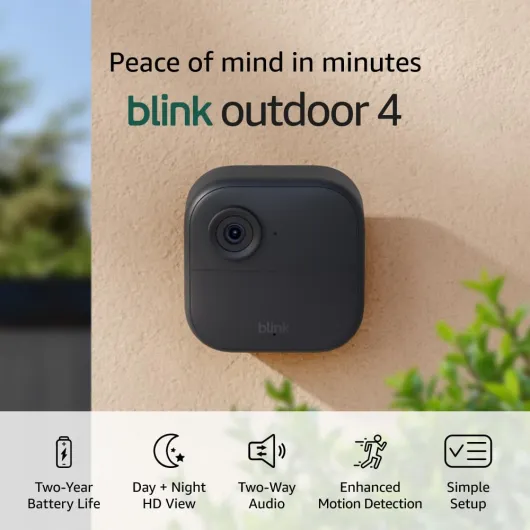
Design and installation: compact, discreet, but some mount frustrations
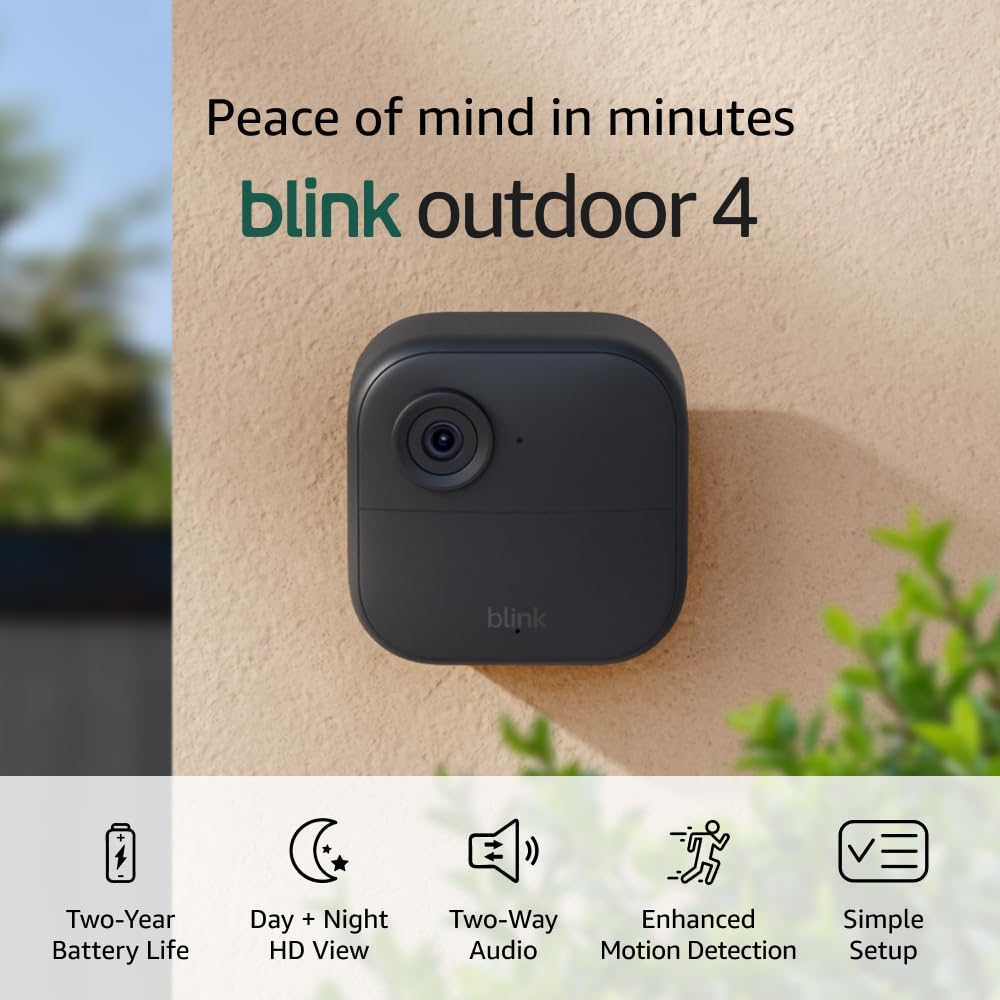
The overall design is pretty straightforward: small black square-ish cameras (about 2.8 x 2.8 x 1.6 inches, 141 g) with a clean, plastic housing. They’re not flashy, which I actually like for security gear. They blend into most exteriors, especially if you’ve got darker trim or brick. The field of view is 143° diagonal, so you get a wide shot without going into crazy fisheye territory. For typical driveway or backyard coverage, that angle is perfectly fine.
Mounting is where things get a bit annoying. The included mounts are basic pivot-style brackets. They technically work, but snapping the camera onto the base can take a lot more force than you’d expect. One of the Amazon reviewers mentioned having to push it down hard on the floor to get it to click in, and that’s not far from my experience. It’s not impossible, but you definitely feel like you’re going to break something the first time. If you’re mounting high up or on a ladder, that’s a pain. For some spots, I honestly think aftermarket mounts or housings are worth the extra few bucks just for easier handling and more flexible angles.
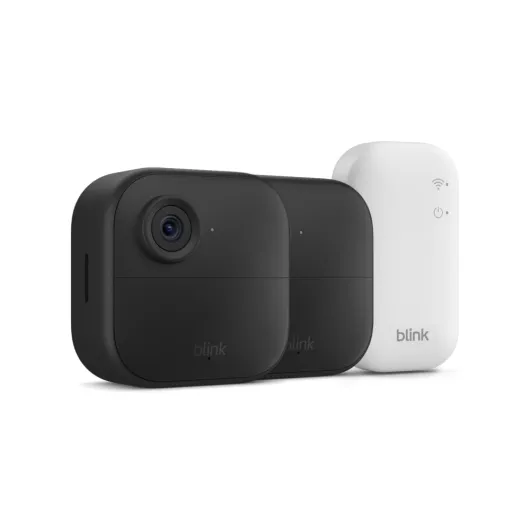
Once mounted, the cameras are low-profile and don’t scream "expensive gadget" from a distance. They look more like basic plastic pucks. That’s good if you don’t want to attract attention, but if you like gear that feels premium in the hand, this is not that. It’s very much functional plastic. The Sync Module Core is a small, unobtrusive white box that sits near your router and stays plugged in. It doesn’t take much space and you can easily hide it behind other gear.
From a usability standpoint, the design works, but it’s clear Blink cut a few corners to keep costs down: stiff mounting interface, very basic hardware, and no built‑in local storage on the module. None of it is a deal breaker if you just want something that works and you’re willing to wrestle the mounts for a few minutes. But if you’re expecting premium build or super flexible mounting options out of the box, you’ll probably find the design just "okay" at best.
Battery life promise vs reality and what affects it
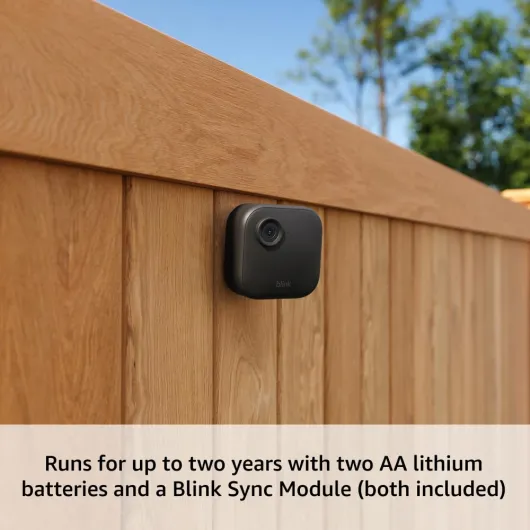
The big selling point Blink pushes is “up to two-year battery life” on the Outdoor 4 using the included AA Energizer lithium batteries. In my experience with Blink gear in general, that number is achievable only under pretty light usage: a few clips per day, moderate temperatures, and default settings. If you crank up the sensitivity, record long clips, or live view a lot, you’re not getting two years. You’ll probably land closer to several months to a year, which is still decent but not as magical as the marketing makes it sound.
Conditions matter a lot. The operating temperature range is listed as -4 to 113°F. If you live somewhere very cold or very hot, lithium batteries hold up better than alkaline, but you’ll still see faster drain at the extremes. If the camera is in a high-traffic area, like pointing directly at the street or a busy sidewalk, it’s going to wake up constantly, record more, and chew through batteries quicker. I’ve had similar Blink cameras in quiet backyard spots last well over a year, while ones facing the street needed new batteries in under 6–8 months.
One thing to keep in mind: the batteries are non‑rechargeable lithium AAs. They’re not the cheapest, especially if you have multiple cameras. If you have four or five cameras, replacing all of them at once adds up. You can try rechargeables, but Blink officially recommends lithium, and rechargeables often have lower voltage, which can cause weird behavior or shorter indicated life. So budget a bit for batteries or plan your camera placement and motion settings to reduce unnecessary triggers.
On the positive side, the cameras don’t seem to drain much when idle, and the app gives you a basic battery status (though it’s not super granular). If you’re realistic and assume 1 year-ish in a busy spot and more in a quiet one, you won’t be too disappointed. Just don’t buy this thinking you’ll slap it up, forget about it for two full years, and never touch it again. That’s possible, but only if the camera barely records anything and lives in nice mild weather.
Weather resistance and long-term reliability (and the Sync Module weak spot)
In terms of physical durability, the cameras hold up reasonably well outdoors. They’re built for outside use, and the housing feels sealed enough to handle rain, dust, and general weather. I’ve had older Blink Outdoors sit through heavy rain and snow without water getting inside, and the Outdoor 4 is in the same league. The operating temperature range of -4 to 113°F is fine for most climates, though if you’re in very harsh conditions, I’d avoid mounting them in spots with direct sun all day or where ice builds up.
The plastic itself is not fancy, but it doesn’t feel like it’s going to crumble. If you’re rough when snapping it onto the mount, you might scratch it a bit, but that’s cosmetic. Once it’s on the wall and you stop fiddling with it, it just sits there and does its job. The 1‑year limited warranty is pretty standard for this type of product – nothing generous, but not terrible either. It’s more of a "we’ll cover early failures" safety net than a long-term guarantee.
Where durability becomes more questionable is on the system side, especially the Sync Module. Several users pointed out that quick power blips can basically wreck the system configuration. You end up having to delete the whole setup in the app, re‑add the Sync Module, then re‑add every camera and redo all your settings. That’s not what I’d call robust behavior. Some people got around it by plugging the Sync Module into a UPS (battery backup), which is a good workaround, but it’s also extra hardware and cost you might not have planned on.
There’s also the issue of firmware updates pushed by Blink. One reviewer described their whole property setup going down right after a Sync Module update, with no easy way to recover and support insisting the router was at fault. That kind of thing undermines trust. The cameras themselves seem durable, but if the brains of the system (the Sync Module) can get “bricked” by updates or power events, then overall reliability takes a hit. So physically, the hardware is fine for outdoor use; logically, the system could be more resilient. If your cameras are at a remote property you can’t visit often, that’s a real concern.
Video quality, motion detection and app experience in real life
On the performance side, the Blink Outdoor 4 is pretty solid for the price, but you need to know its limits. The 1080p video is clear enough to see faces, license plates at close range, and general activity around your house. It’s not cinema quality, but for security clips it does the job. Daytime footage looks crisp and colors are decent; you can easily tell what’s going on. Night vision switches to black and white infrared, and it’s better than I expected at this level. You can clearly see people and animals within a reasonable range, as long as they’re not 50 meters away in the dark.
Motion detection is where Blink has improved things a bit with this generation. You get dual-zone, enhanced motion detection, and you can tweak sensitivity and activity zones in the app. In practice, once I dialed in the settings, it stopped firing for every car passing on the street and focused more on the driveway and front steps. One user mentioned their Outdoor 4 detecting vehicles at over 200 ft and people at over 100 ft – that sounds about right for open, unobstructed views. The downside is that if you place the camera facing a busy road and don’t tune it properly, you’ll drown in notifications.
The app itself is fairly intuitive. You can jump into live view, talk through the camera, review clips, arm/disarm, and adjust all the settings. Customization is actually a strong point: you can tweak motion zones, clip length, retrigger time, and more. The two-way audio is decent – you can hear and be heard clearly enough for short interactions, like telling a delivery person where to leave a package. There’s a bit of lag sometimes, especially on weaker Wi‑Fi, but nothing outrageous for a wireless camera.
Where performance takes a hit is reliability when something goes wrong with power or network. Several people, including one very detailed reviewer, reported that quick power blips can basically crash the whole system when a Sync Module is involved. Instead of gracefully rebooting and reconnecting, the module sometimes gets stuck and requires a full delete-and-reinstall of the system in the app. That’s not a quick fix; you’re re‑adding the module and cameras, then redoing all your settings. If your house has flaky power and you’re not using a UPS, this can turn into a recurring headache. So performance is good when it’s running, but recovery from issues is not very robust.
What’s actually in the box and what this kit can (and can’t) do
This kit is basically Blink’s entry-level outdoor system: two Outdoor 4 cameras plus the Sync Module Core. In the box you get two black cameras, each powered by two AA lithium batteries (included), two basic mounting kits, the Sync Module Core, a USB‑C cable, and a power adapter for the module. There’s no MicroSD card or USB flash drive because the Core module doesn’t support local storage by itself. That’s a key point: if you want local recording, this specific module is useless for that and you’ll need to buy a different sync module.
The cameras are wireless, which means they talk to the Sync Module over your home Wi‑Fi (2.4 GHz only). The module then handles the connection to Blink’s servers and your app. You control everything through the Blink Home Monitor app (iOS, Android, or Fire OS). They also integrate with Alexa so you can do things like show the live view on an Echo Show or arm/disarm with your voice. No native Google Home or HomeKit support, so if you’re deep in those ecosystems, this might not fit nicely.
Feature-wise, the Outdoor 4 gives you 1080p HD video, infrared night vision, two‑way audio, motion detection with adjustable zones, and optional person detection if you pay for the Blink subscription. By default, you get a 30‑day trial of cloud storage, then you either subscribe or lose cloud recording. You can still get notifications and live view without a plan, but the whole point of a security camera is to have recordings, so realistically you’ll either pay monthly or invest in the more capable sync module plus local storage.
In daily use, what this system really offers is pretty simple: motion clips when someone walks into your zones, the ability to pull up live video from your phone, and some level of deterrent because people see a camera. It’s not a high-end NVR system and it’s not meant to be. If you’re okay with the subscription angle and the dependence on the Sync Module, you get a reasonably capable system for the money, but it’s not the most flexible or future-proof setup out there.
Pros
- Good price for a two‑camera wireless outdoor kit with 1080p video and night vision
- Easy setup and a fairly intuitive app with lots of motion and recording settings
- Battery-powered and truly wireless, with realistic battery life of many months in normal use
Cons
- Sync Module Core is unreliable after power blips and doesn’t support local storage
- Strong push toward paid cloud subscription after the 30‑day trial
- Included mounts are stiff and awkward to snap on, making installation more annoying than it should be
Conclusion
Editor's rating
The Blink Outdoor 4 two‑camera system is a practical, budget-friendly option if you want simple wireless coverage around your home without running cables. The cameras are easy enough to install, the video quality (day and night) is perfectly usable, and the motion detection is effective once you spend a bit of time tuning zones and sensitivity. Battery life is decent as long as your cameras aren’t constantly recording, and the app gives you plenty of control without being confusing. For a lot of people, this will be “good enough” security at a reasonable price.
That said, it’s not without headaches. The Sync Module Core is clearly the weak link: it doesn’t support local storage by itself, it can misbehave after power blips, and some users have had full system outages after firmware updates. If your property has unstable power or is far away, that’s a real problem because fixing it usually means deleting and re‑adding everything. Add in the push toward subscriptions once the 30‑day trial ends, and the value story is less clean than it looks at first glance.
I’d say this kit is for people who want low-cost, wireless outdoor cameras, are okay with a subscription or buying an upgraded Sync Module later, and don’t mind doing a bit of tinkering if the system hiccups. It’s also fine if your cameras are on a property you can easily visit when something goes wrong. If you want rock-solid reliability, no subscriptions, and local storage out of the box, or you’re setting this up in a remote place you can’t reach often, I’d look at other systems or at least plan for a UPS and a better Sync Module. Overall, a good value package with clear trade-offs that you should go into with your eyes open.