
Summary
Editor's rating
Value for money compared to other CFexpress options
Design, size, and day-to-day handling
Packaging and what’s (not) included
Build quality and durability in real shooting conditions
Real-world performance: buffer clearing, bursts, and offload speeds
What you actually get with this Lexar CFexpress Type A card
Pros
- Very fast write and sustained speeds suitable for 4K/8K and long bursts
- 512GB capacity reduces how often you need to swap cards on long shoots
- IP68-rated and drop-tested design with lifetime-limited warranty and recovery tool
Cons
- Still expensive compared to SD and lower-end cards
- No included card case or reader despite the price

Specifications
View full product page →| Brand | Lexar |
A CFexpress Type A card that keeps up with modern cameras
I’ve been using this Lexar 512GB Professional CFexpress Type A Silver 4.0 card mainly in a Sony A1 and a Sony A7S III for a mix of photo bursts and 4K/8K video tests. I also borrowed a friend’s Canon body that supports CFexpress to see how it behaves across brands. In short: it’s a high-speed card that actually feels fast in real use, not just on the spec sheet, and 512GB is a comfortable capacity if you shoot a lot in RAW or high-bitrate video.
What stood out right away is how the buffer almost never choked on the A1. Long bursts in compressed RAW + JPEG just kept going way longer than I realistically need. For video, I tried 4K 120p and 8K clips on the Sony, and the card handled it fine, no random recording stops, no weird overheating warnings related to the card. So on the performance side, it basically gets the job done without drama.
On the other hand, this is still a CFexpress Type A card, so the price is not exactly friendly. It’s cheaper than some Sony-branded options, but you still feel the hit to your wallet, especially when you realize you probably want at least two cards if you shoot professionally. Also, to really see the top read speeds when offloading, you pretty much need a fast reader, ideally Lexar’s own USB 4.0 reader, which is extra cost again.
Overall, my first impression after a couple of long shoots is that this Lexar Silver 4.0 card is a pretty solid workhorse. It’s not magic, it won’t make bad photos good, but it keeps up with modern high-frame-rate cameras and 8K workflows. If you’re upgrading from SD cards or older, slower CFexpress, you’ll clearly feel the difference, especially in buffer clearing and offload times.
Value for money compared to other CFexpress options
CFexpress Type A cards are not cheap, and this Lexar 512GB Silver 4.0 is no exception. That said, compared to Sony’s own Type A cards and some other big brands, the Lexar usually comes in at a lower price for the same capacity and similar or better speed ratings. So in the CFexpress world, it’s actually on the more reasonable side, even if the number still hurts when you hit “buy”.
In terms of what you get for the money, you have: high read/write speeds, good sustained performance for video, a decent 512GB capacity, an IP68 rating, and a lifetime-limited warranty. In real use, it lets you shoot long bursts and high-bitrate video without worrying, and it cuts down offload times at the end of the day. If you’re shooting professionally and time is literally money, that performance difference versus SD or cheaper, slower cards can pay for itself over a season of work.
If you’re more of a hobbyist or you mostly shoot casual stills and some light 4K, then honestly, this might be overkill. You could save money with a smaller capacity or a slower card and probably not notice much difference. The Lexar Silver 4.0 series really makes sense if you’re pushing your camera hard: 8K, 4K 120p, or heavy bursts on something like a Sony A1, A9 series, or a Canon body that can fully use these speeds.
So from a value angle, I’d call it good value for money within its category, but the whole category is expensive. For demanding shooters, it’s a sensible compromise between performance and price. For casual users, there are cheaper ways to store photos that will feel just as good in day-to-day use.
Design, size, and day-to-day handling
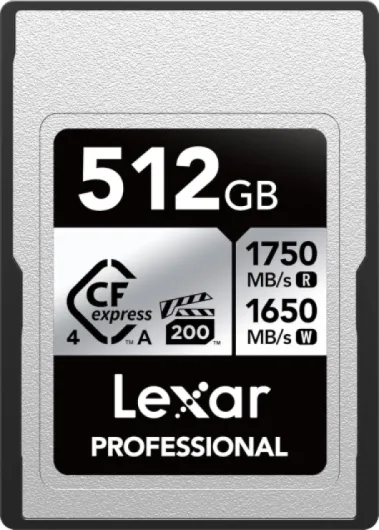
Design-wise, there isn’t much to say: it’s a small CFexpress Type A card with a silver label. The label is clear enough, with the capacity and Lexar branding easy to read at a glance in a card wallet. That sounds minor, but when you’re juggling multiple cards under time pressure, being able to quickly spot the 512GB one versus a smaller one is actually useful. The silver look also helps it stand out from the typical black SD cards in the same pouch.
The size is the usual Type A standard, so no surprises there. It slides cleanly into Sony Alpha/FX card slots and locks in without any wobble. Ejecting it is also straightforward; the edges are just grippy enough to pull out, even with slightly sweaty hands. Compared to larger CFexpress Type B cards, the smaller Type A format is a bit easier to lose if you’re not careful, so I’d still recommend a proper card case.
There are no fancy design extras here: no rubberized coating, no big color coding system, nothing like that. It’s a simple, functional design. The print on the label hasn’t rubbed off yet despite going in and out of slots and card holders a lot, which is more than I can say for some cheaper brands where the capacity text fades quickly.
Overall, the design is practical and low-key. It doesn’t feel cheap, but it’s also not some premium object you admire. It’s just a tool that’s easy to identify and easy to handle, which is basically what I want from a memory card.
Packaging and what’s (not) included
The packaging is pretty basic: a small cardboard and plastic blister pack with the card inside. Nothing fancy, nothing wasteful, but also nothing that makes you feel like you’re unboxing a premium gadget. Personally, I don’t care much about packaging for a memory card, but if you expect a nice case or any extras, this isn’t it. Once you tear it open, you’ll probably throw the packaging away and never think about it again.
Inside, you only get the card itself and a small paper insert with warranty and basic info. There’s no included card reader, no storage case, and no printed license code card for the recovery tool; that’s handled online via Lexar. I would have liked at least a simple plastic card holder, especially at this price level. Not a deal-breaker, but it would make the initial experience feel a bit more complete.
On the positive side, it’s quick to get going. You open the pack, slot the card into your camera, format it, and you’re ready to shoot. No bloat, no extra registration steps needed to make the card work. The warranty and recovery tool details are there if you want them, but they don’t get in your way if you just want to start using the card immediately.
So, packaging-wise, it’s nothing special but effective. It protects the card during shipping, keeps things compact, and doesn’t add much clutter. Just don’t expect any nice accessories or thoughtful extras in the box. What you’re paying for here is the card itself and the performance, not the unboxing experience.
Build quality and durability in real shooting conditions
Lexar markets this card as IP68-rated and drop-proof up to 5 meters. I didn’t go full torture test with it, but I did use it like I normally do on location: shoved into a crowded card wallet, swapped in and out of cameras in the rain, and occasionally dropped on the floor of a studio or on rough pavement. After a few weeks of this kind of use, there’s some light cosmetic wear, but nothing that affects how it sits in the slot or how it performs.
The casing feels solid enough. It doesn’t flex when you pinch it, and the edges are clean, so it slides into the camera slot without snagging. Compared to some cheaper cards I’ve used, the contacts also look better protected. I had no read or write errors, no random disconnects, and no overheating warnings tied to the card, even during long 4K recording sessions. The camera body got warm, but the card itself never became worryingly hot to the touch when I pulled it out after a long take.
I also like that it’s rated for dust and water. I shot one afternoon in light rain and mist, swapping lenses and cards under a jacket. The card got a bit damp, I wiped it quickly on a shirt, popped it back in, and it kept going. That’s the kind of basic abuse I expect a pro-oriented card to handle. I wouldn’t go swimming with it, but for real-world location work, it feels up to the job.
So, from a durability perspective, I’d say it’s pretty solid. It’s not some indestructible tank, but it feels more robust than budget cards and on par with other big brands I use. If you’re rough on your gear, this seems like it can handle regular field use without turning into a reliability headache after a few months.
Real-world performance: buffer clearing, bursts, and offload speeds
The big question with any CFexpress card is simple: does it choke when you push it? With this Lexar 512GB Silver 4.0, I tried to be a bit rough. On the Sony A1, I held down the shutter in compressed RAW at high drive mode. The buffer filled eventually, but it took a while, and once I stopped shooting, the buffer cleared noticeably faster than with my older CFexpress Type A and way faster than any SD card. So the claimed high write speed does show up in real use, not just in a benchmark window.
For video, I tested 4K 60p and 4K 120p in high-bitrate modes, plus short 8K clips. The card kept up without random stops or dropped recordings. The VPG200 rating basically means it can handle at least 200 MB/s sustained video data, and that seems accurate. I didn’t get any warnings or skipped frames that I could spot when scrubbing through footage in Premiere. It behaved like a card you can trust for important video work, which is the main point here.
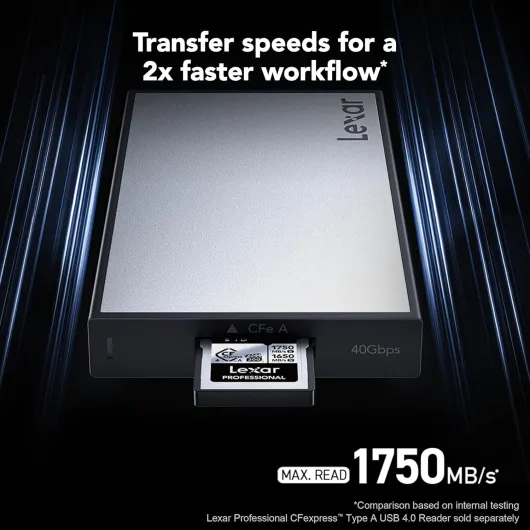
On a desktop with a fast Lexar reader (not the newest USB 4.0 one, but still decent), I saw read speeds in the 900–1100 MB/s range and writes a bit lower. Not the full 1750/1650 MB/s that’s advertised, but that’s pretty standard: real-world speeds depend on the reader, cable, and drive you’re copying to. Still, copying a full wedding day or a day of wildlife shooting is much quicker compared to SD or older CFexpress 2.0 cards I’ve used. You feel it when backing up late at night.
Is it the absolute fastest card on the planet? Probably not, and if you only shoot casual stuff, you won’t notice the difference versus slower cards. But for high-frame-rate stills and heavy video, it keeps up without drama. For me, that’s what matters: I press record or hold the shutter and don’t have to think about the card. On that front, it delivers pretty well.

What you actually get with this Lexar CFexpress Type A card
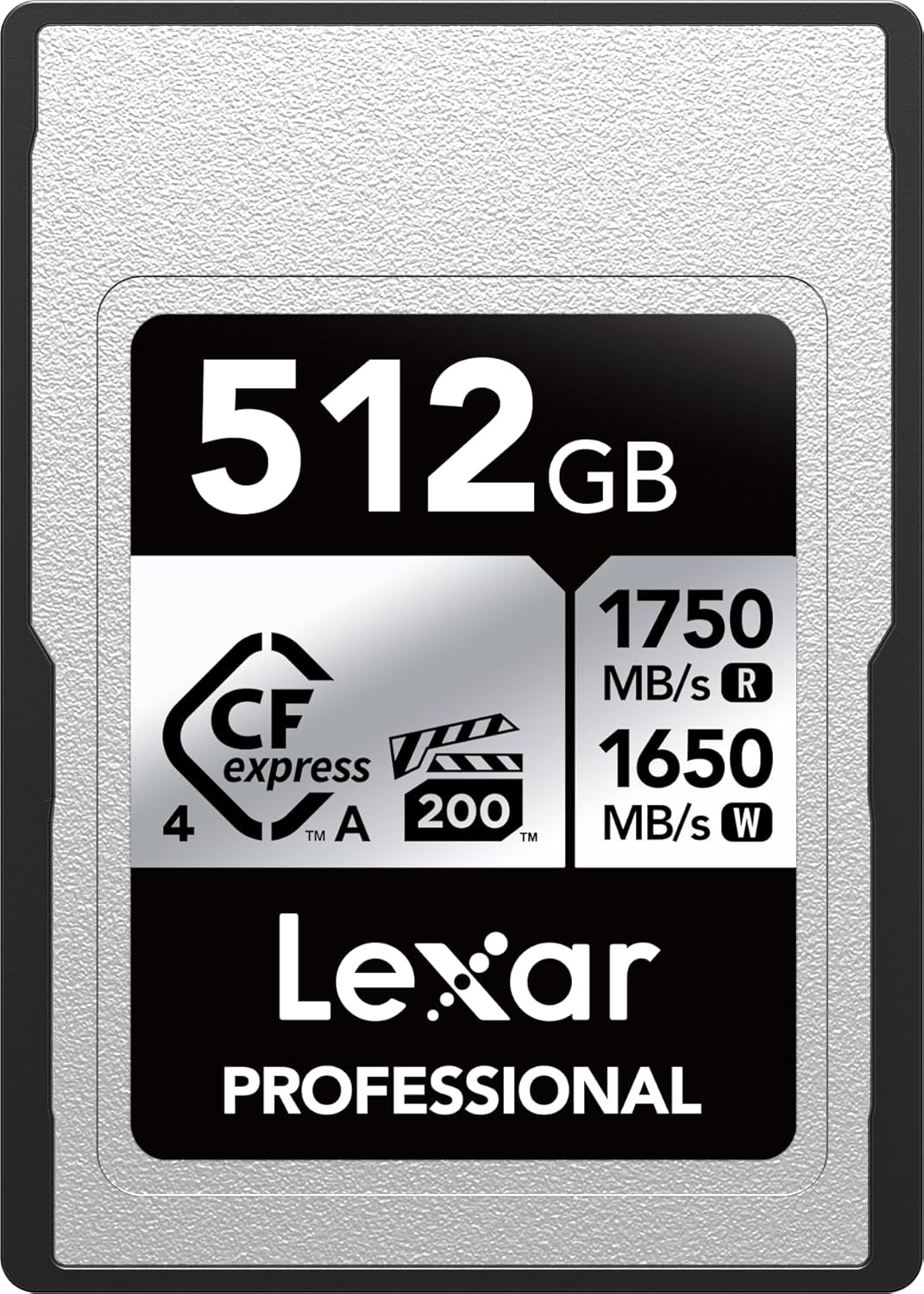
The product name is long, but the idea is simple: this is a 512GB CFexpress Type A Silver 4.0 card aimed at photographers and videographers using high-end bodies like Sony Alpha / FX and newer Canon models that support CFexpress. Lexar advertises up to 1750 MB/s read, 1650 MB/s write, and around 1300 MB/s sustained write, plus a VPG200 rating, which basically means the card should handle heavy video bitrates without dropping frames.
In the box, you get the card and that’s it. No reader, no fancy pouch, no adapter. Just a small plastic shell and some basic documentation. You do get a lifetime-limited warranty and access to Lexar’s recovery software, which is nice to have in the background if something goes wrong. I haven’t had to use the recovery tool yet, so I can’t say how good it is, but at least it’s there instead of being an extra paid add-on.
Lexar also pushes the durability angle: the card is IP68-rated (dust and water resistance) and drop-tested up to 5 meters. I didn’t throw it off a roof, but I did drop it onto concrete a couple of times by accident while swapping cards out of a crowded pouch, and it still works fine, no cracked casing, no weird behavior in camera. I also used it in light rain and dusty conditions; again, no issues so far.
So in terms of what you’re actually buying: it’s a high-speed, mid-range (Silver line, not the top Gold line) card with solid advertised numbers, decent capacity at 512GB, and some peace-of-mind extras like the warranty and recovery tool. Nothing fancy in the package, nothing flashy in the branding, but on paper it checks the main boxes for serious photo and video work.
Pros
- Very fast write and sustained speeds suitable for 4K/8K and long bursts
- 512GB capacity reduces how often you need to swap cards on long shoots
- IP68-rated and drop-tested design with lifetime-limited warranty and recovery tool
Cons
- Still expensive compared to SD and lower-end cards
- No included card case or reader despite the price
Conclusion
Editor's rating
After using the Lexar 512GB Professional CFexpress Type A Silver 4.0 card across a few demanding shoots, my takeaway is simple: it’s a fast, reliable card that behaves like a proper work tool. Buffer clearing is quick, 4K and 8K recording run smoothly, and I didn’t run into any weird glitches or file issues. The 512GB capacity is a nice sweet spot if you shoot a lot of RAW or long video sessions and don’t want to swap cards constantly.
It’s not perfect. The price is still high compared to SD cards, there are no useful extras in the box, and to really see the top speeds you’ll want a good reader, ideally Lexar’s own. But in practice, it does what you actually need: it keeps up with modern Sony and Canon bodies, handles rougher conditions thanks to the IP68 rating, and comes with a lifetime-limited warranty and recovery software as a bit of safety net.
If you’re a serious photographer or videographer who shoots high frame rates, high bitrates, or 8K, this card makes sense and feels like a solid investment. If you mostly shoot casual photos, light 4K, or you’re on a tight budget, this is probably more card (and more money) than you really need. For people who push their cameras hard, though, it’s a pretty solid balance of performance, reliability, and price within the CFexpress Type A world.