
Summary
Editor's rating
Value: worth paying more than the cheap brands?
Design: looks decent, practical enough, with one annoying tiny key
Battery: decent life, but the non-removable design is a trade-off
Durability and reliability: how it holds up and what Ring promises
Performance: notifications, video quality and app experience
What this Ring doorbell actually does (and doesn’t)
Pros
- Quick, reliable notifications and live view when Wi‑Fi is decent
- Good 1440 x 1440 video with head‑to‑toe view and colour night vision
- Easy setup and solid app with useful motion zones and integration with Alexa/Ring ecosystem
Cons
- Non-removable built-in battery means taking the whole unit down to charge if not hardwired
- Most of the smarter features (recordings, person/package alerts) require a paid subscription

Specifications
View full product page →| Brand | Ring |
A quick word before you drill into your wall
I’ve been using this Ring Battery Video Doorbell for a bit now, and I’ll be honest: I bought it because I was sick of missing deliveries and random people knocking without knowing who it was. I’m not a smart home geek, I just wanted something that alerts my phone and lets me talk through the door when I’m not home. So this review is very much from a regular user point of view, not someone trying to justify a huge tech setup.
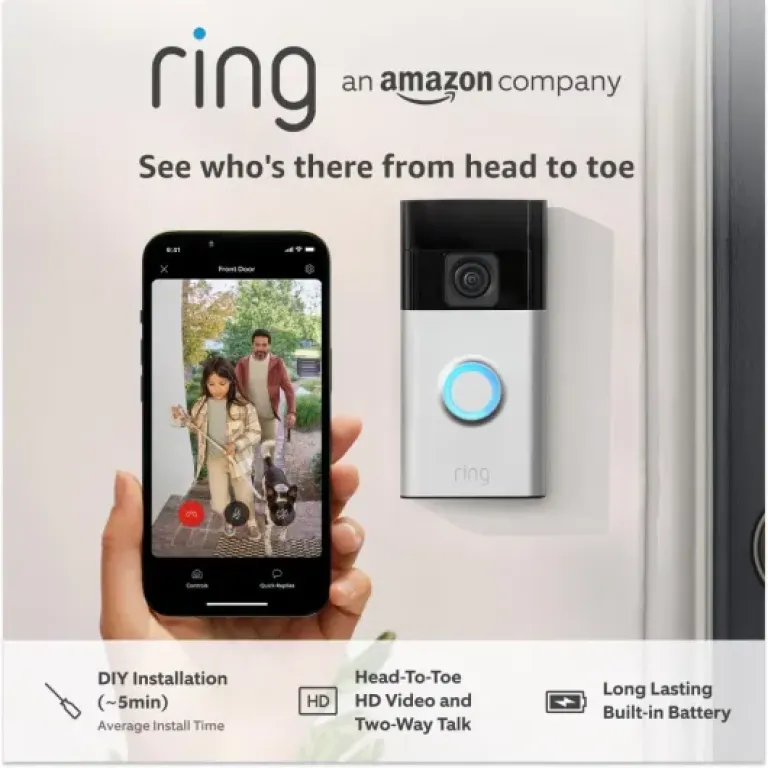
Out of the box, the whole thing looks fairly straightforward: doorbell, bracket, screws, a USB‑C cable and that tiny orange key to release it from the mount. I installed it myself with a basic drill and a step ladder. It took more than 5 minutes in my case, closer to 20, but that’s mainly because I measured and re-measured the holes like a coward. Still, compared to wired doorbells I’ve seen friends struggle with, this is pretty manageable.
The big promise with this model is wireless, head‑to‑toe video, colour night vision, and app control. In real life, what matters is: do notifications come quickly, is the image clear enough to recognise faces and parcels, and how often do you need to charge it? Also, is the subscription basically mandatory, or can you live without it? Those were my main questions going in.
So if you’re hesitating between this and some cheaper no‑name video doorbell, I’ll walk through how it actually behaves day to day: installation, design, performance, battery and whether the subscription feels like a cash grab or a fair trade. It’s not perfect, but it does a lot of things pretty well, and there are a couple of details that might annoy some people depending on how you plan to use it.
Value: worth paying more than the cheap brands?
On value, this Ring sits in that middle zone: not crazy expensive, but definitely pricier than the random no‑name video doorbells you see online. I’ve tried cheaper brands before, and the main difference I noticed here is reliability and speed. With the bargain models, there was always a delay connecting, or the app would bug out, or notifications would arrive way too late. With this Ring, the connection is pretty much instant in comparison, the app is cleaner, and the integration with Alexa and other Ring devices actually works without constant fiddling.
That said, you have to factor in the subscription cost. The doorbell itself is a one‑time purchase, but if you want recordings, person alerts, package alerts and proper history, you’ll end up paying monthly after the 30‑day trial. If you’re on a tight budget and only care about answering live when someone rings, you might find that annoying. For me, being able to go back and check what happened when I was away is kind of the whole point, so I see the subscription as part of the price of this ecosystem.
Compared to cheaper doorbells, you’re basically paying for: a more polished app, better motion zones, more stable notifications, solid video quality, and decent support/warranty. If you just want something basic and don’t care if the app is clunky, a budget brand might be enough. But if you’re the one who ends up doing tech support for the whole family, paying a bit more for something that just works more consistently feels worth it.
Overall, I’d say the value is good, especially if you catch it on sale like a lot of people did (some grabbed it around £40 which is very good). At full price, it’s still reasonable if you actually plan to use the features and don’t mind the subscription. If the idea of ongoing fees annoys you and you only want free local recordings, then this isn’t the right product. But if you’re okay living in the Ring ecosystem, it’s a solid balance between price, performance and convenience.
Design: looks decent, practical enough, with one annoying tiny key
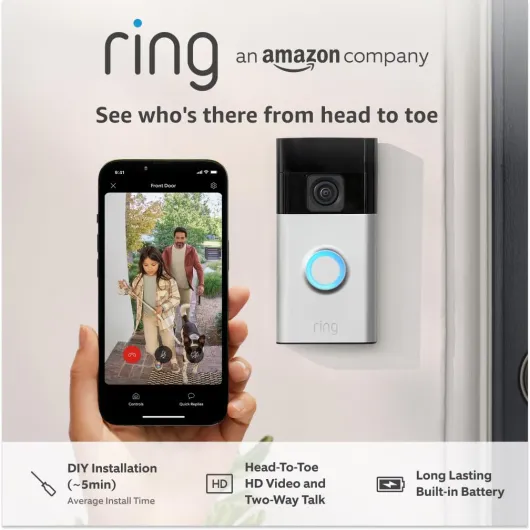
Design-wise, it’s pretty straightforward. The version I tried was the Satin Nickel finish, which is basically a brushed metal look on a plastic body. It doesn’t scream luxury, but it looks clean and fits fine next to most front doors. There’s also a Venetian Bronze option if you want something darker and a bit more discreet. Size-wise, it’s not tiny: about 12.6 cm tall and 6.2 cm wide. On the wall it’s noticeable, but it doesn’t look like a big CCTV camera either.
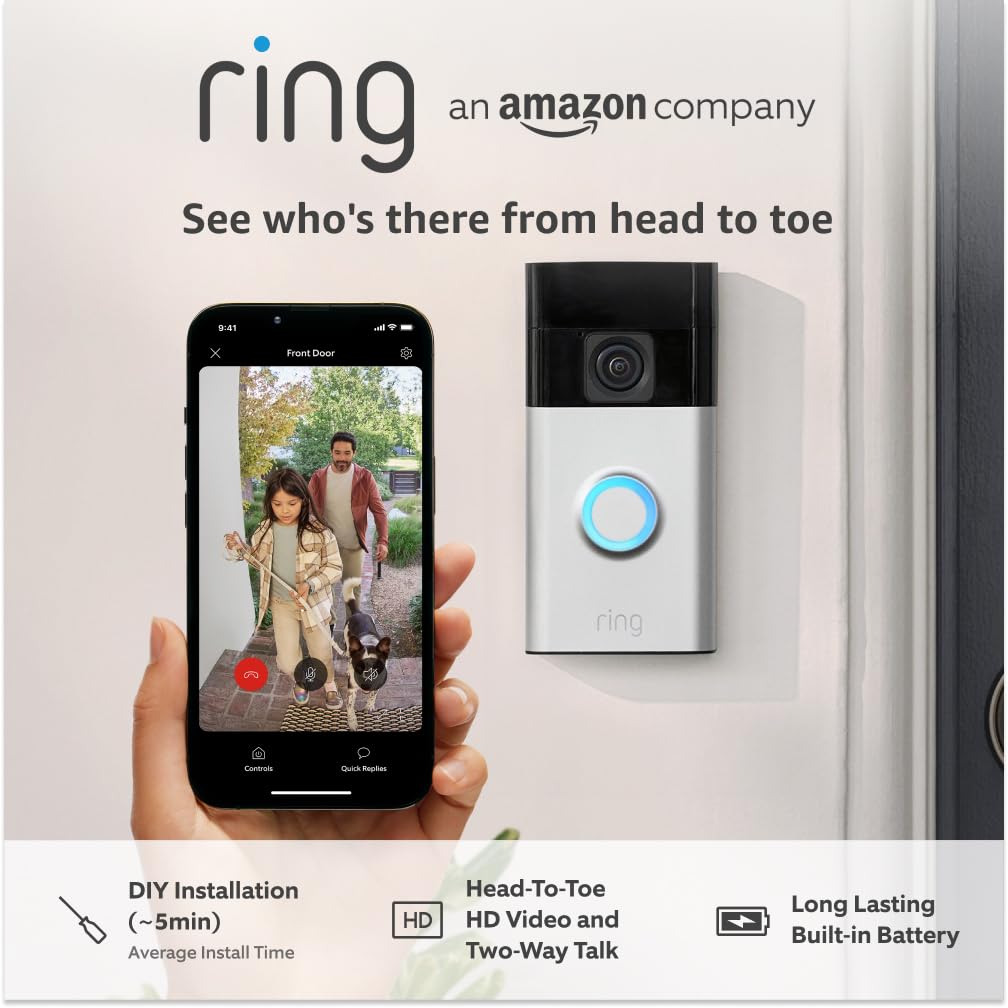
The front has the camera at the top, a big round button with an LED ring, and that’s about it. The button is easy to press, even for kids or older people, and the light ring helps visitors understand it’s a doorbell, not some random sensor. One thing I liked is that you can see clearly when it’s recording or when it’s in setup mode; there are audio prompts too, so you’re not guessing what’s happening while pairing it with the app.
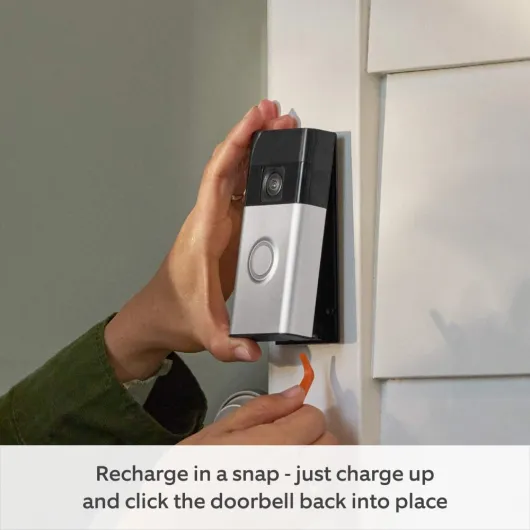
The part I’m less convinced about is the mounting and release system. The doorbell clips onto a plastic bracket that you screw into the wall. To remove the doorbell (for charging or moving it), you have to use this tiny orange plastic key that goes into a small hole underneath. It works, but the key is small enough that losing it is pretty easy if you’re not careful. You can improvise with other tools if you’re handy, but it’s not as convenient as just sliding out a removable battery like some older Ring models.
From a day‑to‑day perspective, the design feels thought‑out enough: good field of view, big button, visible indicator lights. It doesn’t look cheap, but it also doesn’t look like a premium metal gadget. I’d call it practical and decent-looking, with that one slightly dumb detail of relying on a tiny key for removal. If you’re fussy about aesthetics, the Satin Nickel is neutral enough for most doors, and the Bronze option looks nicer in my opinion if your door and hardware are darker.
Battery: decent life, but the non-removable design is a trade-off
The power side is where this model is a bit different from some older Rings. It has a built-in, non-removable battery, which means you don’t slide out a pack and swap it. When it needs charging, you have to unclip the whole doorbell from the wall using that small orange key, bring it inside, and plug it in via USB‑C. On the positive side, USB‑C is nice because you probably already have a bunch of those cables lying around. On the negative side, you’re taking the whole unit down each time instead of just a battery.
Battery life will depend a lot on how busy your front door is and how aggressive your motion settings are. With medium motion sensitivity, person alerts on, and a few live views per day, you’re probably looking at several weeks to a couple of months between charges. If your door faces a main road or a shared path and the camera is constantly triggering, that will drop. The app shows you the battery percentage and lets you tweak settings like motion frequency, snapshots, and recording length to stretch the time between charges.
Charging itself isn’t crazy fast, but it’s not painful either. If you don’t let it go to 0% and just top it up when it gets low, you can charge it overnight or during a quiet time and you’re fine. The downside is obvious: while it’s charging, you technically don’t have a doorbell on the wall unless you hardwire it to your existing doorbell transformer for continuous power. If you can hardwire it, that’s clearly the best setup: the battery then acts more like a backup and you don’t have to think about charging at all.
Overall, I’d say the battery situation is good enough but not perfect. The life per charge is fine for most people, but the non-removable design is a step back if you were used to swapping spare batteries on older Ring models. If you’re in a flat or you can’t hardwire, just be aware you’ll be taking the whole unit down now and then to plug it in. Not a dealbreaker, but something to factor in if you hate that kind of maintenance.
Durability and reliability: how it holds up and what Ring promises
In terms of build, the doorbell feels solid enough for outdoor use, but keep in mind it’s still mostly plastic with a metal-look finish. It’s rated to work from -20°C to 50°C, so on paper it can handle both winter and hot summers. Mine has been through a mix of rain, wind and some direct sun during the day, and so far there’s no sign of water getting in or the finish peeling. It doesn’t feel fragile, and once it’s screwed properly into the bracket, it doesn’t wobble or rattle when you press the button.
One thing to watch is direct sunlight. Ring themselves warn that prolonged exposure can heat the device and affect performance. If your door faces full sun all day with no shade, you might see the unit get quite warm. I haven’t had it shut down on me, but I can see how in hotter climates or during heatwaves it could become an issue. If possible, mount it where it’s at least partially sheltered, or under a porch or canopy.
On the software side, Ring promises guaranteed security updates for at least four years after the device stops being sold new. That’s actually quite important for a connected camera sitting on your front door. It means it shouldn’t become a security hole overnight. The app itself has been stable for me: no random crashes, and live view loads reliably most of the time. Occasionally it takes a few extra seconds to connect, but nothing dramatic. Wi‑Fi strength obviously plays a big role here.
You also get a one‑year limited warranty and theft protection, which is reassuring given it’s a visible gadget on your front door. If someone rips it off, Ring will replace it under that policy (assuming you follow their rules and file a report). Overall, I’d say durability and reliability are pretty solid for a consumer device. It’s not indestructible, but it feels like it can handle normal weather and daily use without falling apart, and the software support window is clearly stated, which I appreciate.
Performance: notifications, video quality and app experience
On performance, this is where I was pleasantly surprised. I’d heard older Ring models had slow notifications and connection issues, but on this one, with a solid Wi‑Fi connection, notifications are usually within 1–2 seconds of someone pressing the bell. Motion alerts are similar. My broadband is decent (fibre, good router position), and I think that makes a big difference. If your router is far away or your upload speed is weak, expect more lag and maybe some choppy video.
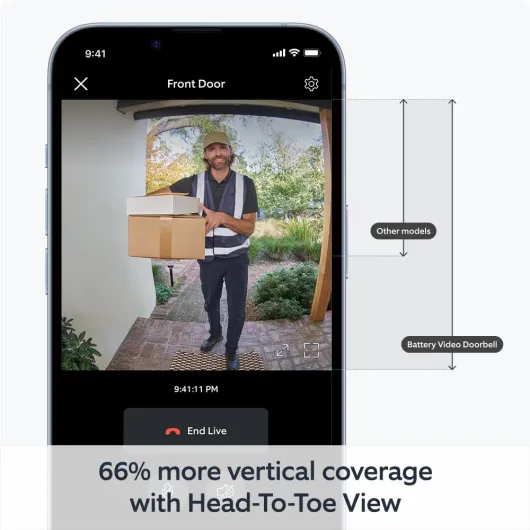
The video quality at 1440 x 1440 is good enough for what this is meant for. Faces are clear, you can read number plates at reasonable distance, and the square format is actually useful for seeing both the person and any parcels on the ground. This “head‑to‑toe” thing isn’t just marketing; it genuinely helps to check if a delivery was left or if someone is trying to be sneaky out of frame. Daytime image is sharp enough, not cinema-level but perfectly usable. At night, colour night vision kicks in and you still get a decent amount of detail. It’s not like daylight, but I can clearly see faces and clothing colours under my porch light.
The two‑way audio is also decent. There’s a slight delay, but nothing that makes conversation painful. People on the other side hear me clearly, and I can hear them without too much background noise thanks to the noise cancellation. I’ve used it to tell delivery drivers where to leave parcels or to tell people I’m not home, and it does the job fine. No weird echo or constant cutting out so far.
Motion detection is where you need to spend some time tweaking. You get custom motion zones, which are basically shapes you draw over the camera view to tell it where to care about movement. That’s pretty important if your door faces a busy street. Once I drew a smaller zone covering just my driveway and front step, the random car alerts dropped a lot. There are also options for person-only alerts and package alerts, but those need the subscription. When set up properly, the false alerts are kept under control, but don’t expect it to be perfect out of the box. Overall, I’d say the performance is pretty solid as long as your Wi‑Fi isn’t trash and you actually spend 10–15 minutes fine-tuning the settings in the app.
What this Ring doorbell actually does (and doesn’t)
On paper, this Ring Battery Video Doorbell is a wireless, battery-powered camera doorbell that connects to your Wi‑Fi (2.4 GHz only) and sends alerts to your phone when someone presses the button or when it detects motion. The video is 1440 x 1440 in a square format, so you get that “head‑to‑toe” view, which basically means you can see the person’s face and the parcel on the floor at the same time. It also has two‑way audio, so you can talk to whoever’s at the door, plus colour night vision so the image doesn’t turn into a grainy black mess after dark.
In practice, everything runs through the Ring app. That’s where you set motion zones, turn person alerts on or off, adjust sensitivity, and check the battery level. You can also link it to other Ring devices or Alexa speakers, and that works fairly well. When someone presses the bell at my place, my phone rings like a call and my Echo devices announce that someone is at the door. No extra chime needed unless you want a more traditional doorbell sound for guests who don’t have access to your account.
The catch is the Ring subscription. Without it, you only get live view and real-time notifications. If you miss an alert, you can’t go back and see what happened. With the subscription, you get video recordings saved for up to 180 days, person and package alerts, and all the event history. The device comes with a 30‑day free trial, and after that you need to pay if you actually want to keep recordings. Realistically, if you buy this for security or to check deliveries later, you’ll probably end up paying the subscription.
Overall, as a product it’s pretty solid: it covers the basics well (see who’s there, talk to them, check recordings) and adds some extras like quick replies (pre‑recorded messages) and privacy zones. The downside is that a good chunk of the interesting stuff is locked behind the subscription, and you need at least half‑decent Wi‑Fi upload speed (Ring says 2 Mbps minimum) if you don’t want lags or pixelated video. So it’s not just the cost of the doorbell; you also need to factor in your internet and the ongoing monthly fee if you care about recordings.
Pros
- Quick, reliable notifications and live view when Wi‑Fi is decent
- Good 1440 x 1440 video with head‑to‑toe view and colour night vision
- Easy setup and solid app with useful motion zones and integration with Alexa/Ring ecosystem
Cons
- Non-removable built-in battery means taking the whole unit down to charge if not hardwired
- Most of the smarter features (recordings, person/package alerts) require a paid subscription
Conclusion
Editor's rating
Overall, the Ring Battery Video Doorbell is a pretty solid choice if you want a wireless video doorbell that works reliably and you don’t mind using an app and a subscription. The setup is simple enough for non‑techy people, the video quality is good day and night, and the notifications are quick as long as your Wi‑Fi isn’t terrible. The head‑to‑toe view and motion zones are genuinely useful, especially if you get a lot of deliveries and want to know whether parcels were actually left at your door.
It’s not perfect. The built-in non-removable battery means you have to take the whole unit down to charge it unless you hardwire it, and that tiny release key is very easy to misplace. The subscription is also basically required if you care about recordings and smarter alerts. If you’re allergic to ongoing fees or you just want a super cheap camera, there are other options, but you’ll probably lose some reliability and polish. For people who already use Alexa or other Ring products, this fits in nicely and feels like a sensible upgrade.
If you want a straightforward, app‑driven doorbell to monitor your front door, handle deliveries better and check in when you’re away, this model gets the job done well. If you expect everything to work perfectly with bad Wi‑Fi, no subscription and zero tweaking of settings, you’ll probably be disappointed. So I’d recommend it to anyone okay with a bit of setup and an ongoing small monthly fee, and less so to people who just want a one‑off purchase with no strings attached.