
Summary
Editor's rating
Is it good value compared to Ring, Nest, and the rest?
Chunky but practical design that actually lights things up
Build quality and weather resistance in real life
Video, motion detection, and night vision: where it shines and where it’s meh
What you actually get with this Lorex floodlight cam
Does it actually make your place feel more secure?
Pros
- Sharp 2K video with good detail day and night, plus decent 10 m night vision
- Local microSD storage included (32 GB) with no mandatory subscription fees
- Bright, adjustable LED floodlights and solid IP65 weather-resistant build
Cons
- Motion detection distance and consistency can be underwhelming if you expect long-range coverage
- App is functional but less polished and intuitive than some big-name competitors

Specifications
View full product page →| Brand | Lorex |
A floodlight cam for people who hate subscriptions
I put this Lorex 2K WiFi Floodlight Camera over my driveway to replace a basic motion floodlight. I’ve had it running for a few weeks now through rain, a bit of wind, and a couple of cold nights. My main goal was simple: decent video, bright lights, and no monthly cloud fees. On that, it mostly delivers. It’s not perfect, but it does the job pretty well once you get through setup and tweak the settings.
What pushed me to try this one instead of the usual Ring/Blink stuff is the local microSD storage. It comes with a 32 GB card already in it, and you can upgrade to a bigger one later. I’m tired of getting nickel-and-dimed with subscriptions just to see who walked up my driveway yesterday. With this Lorex, the clips stay on the card and in the app, and that’s it. No account upgrades, no free trial nonsense that suddenly ends.
Day-to-day, the camera gives clear 2K video, the floodlights are strong enough to light my driveway and a good chunk of the yard, and the app is… fine. Not great, not terrible. The motion detection is where things get a bit mixed. For big movements like cars or people walking up, it’s fine. For longer-distance detection or more precise zones, it can be hit or miss depending on how you point it and how fussy you are.
If you want something that just plugs into your existing electrical box, records locally, and lets you shout at people through your phone, this is a pretty solid option. If you’re picky about super-sensitive motion detection or want a super polished app experience, you might find a few things to complain about here.
Is it good value compared to Ring, Nest, and the rest?
Value-wise, the big selling point here is no mandatory subscription. The included 32 GB microSD card means you can start recording out of the box without paying extra every month. If you want more history, you can bump that up to 256 GB pretty cheaply. Compared to Ring or Nest floodlight cams where you basically need a subscription to get full recording features, this Lorex ends up cheaper in the long run, especially if you plan to keep it for several years.
In terms of features for the price, you’re getting 2K video, bright adjustable LED floodlights, smart motion detection, 2-way audio, a siren, and decent night vision. That’s roughly on par with the big-name competitors. Where Lorex trails a bit is the app polish and the occasional quirks with motion detection range. The app works, but it’s not as slick or idiot-proof as something like Ring’s app. If you’re not very techy, you might need a bit more patience during setup and fine-tuning.
The Amazon rating around 4.1/5 makes sense to me. Most people seem happy with the image quality and integration with other Lorex gear, while a few are annoyed by motion detection limitations. If you already have a Lorex NVR or Fusion system, this is an easy add and the value goes up because it slots into what you already own. If you’re starting from scratch and want a super simple, app-first system, you might find better overall user experience with competitors – but you’ll probably pay for a subscription.
For someone who wants good hardware, local storage, and no recurring fees, I’d call the value pretty good. It’s not bargain-basement cheap, but you’re not paying a premium just for a brand name either. You’re basically trading a bit of app polish for long-term savings and direct control over your footage, which, for me, is a fair trade.
Chunky but practical design that actually lights things up
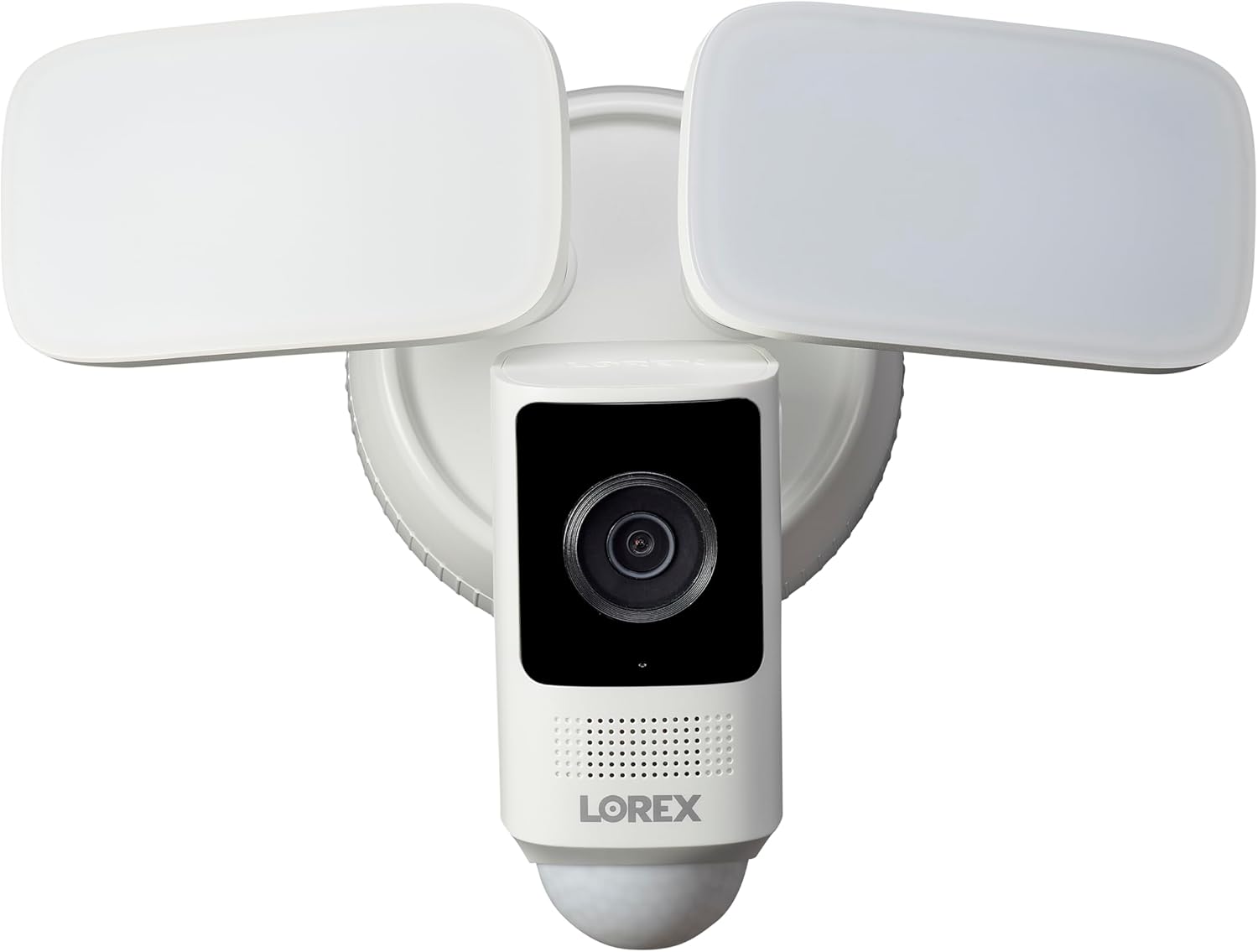
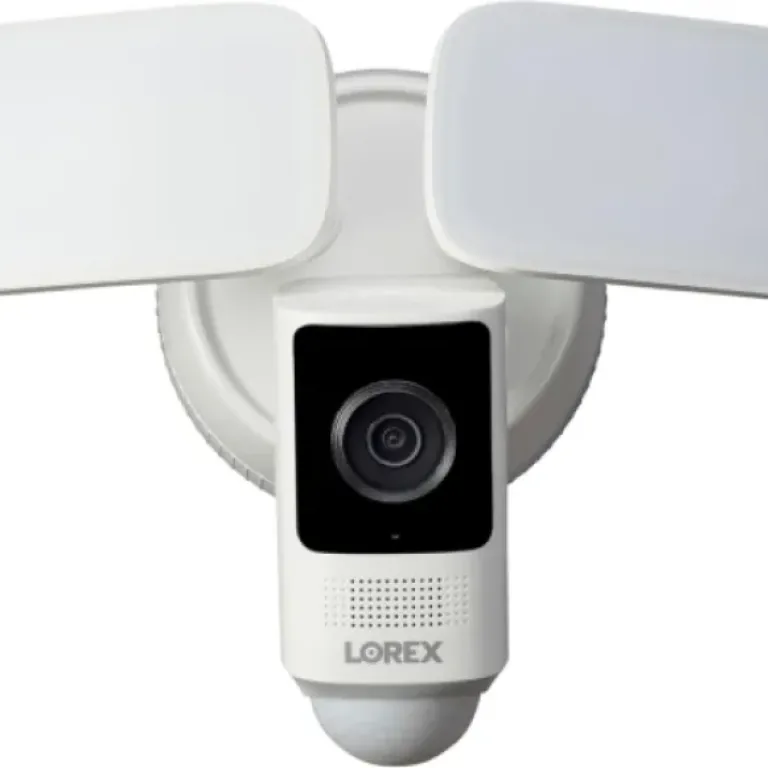
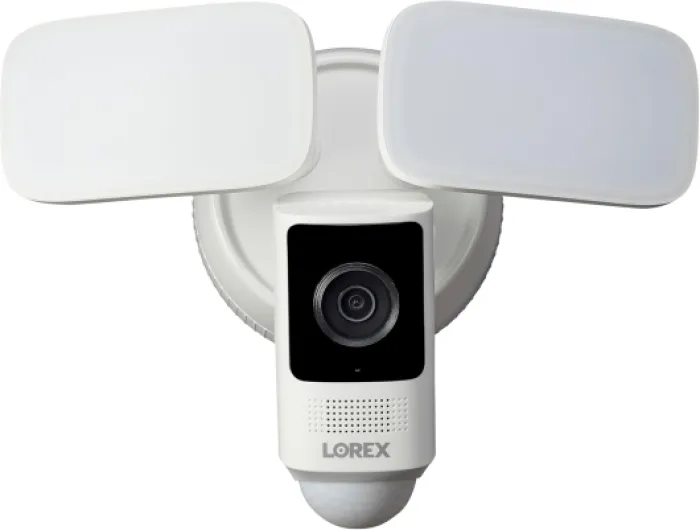
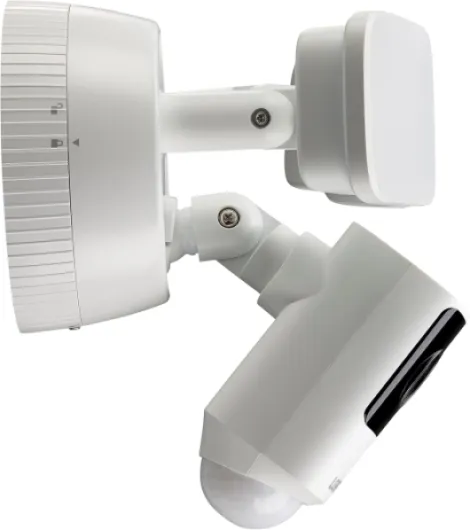
The design is pretty straightforward: a central camera unit with two adjustable LED panels on the sides. It’s not exactly pretty, but for a floodlight cam, I care more about how it lights and what it sees than how Instagrammable it looks. The body feels solid and a bit on the heavier side, which I actually take as a good sign for something that’s going to sit outside in bad weather. It’s clearly built for wall or ceiling/soffit mounting, and the arms are stiff enough that they stay where you put them.
I mounted mine under a soffit, which is a bit trickier than straight on a wall. You do have to put some force into rotating the lights and the camera to get a good angle when it’s upside down, but once set, it doesn’t sag. Other users said the same: a bit of wrestling at first, but then it’s fine. The 122° field of view is wide enough that I didn’t have to angle the camera too aggressively to cover the whole driveway and a slice of the sidewalk.
The white finish is neutral and blends in with most house trims. It doesn’t scream “giant gadget” from the street. The LEDs are fairly big, and when set to the brighter levels, they light up a pretty large area. You can also change the colour temperature between warm and cool. Personally, I think the warm setting looks weird for a floodlight – kind of like stormy sky lighting as one reviewer put it – so I left it on cool white, which feels more natural for security lighting.
From a practical point of view, the design is focused on coverage and adjustability rather than style. It’s not compact, and if you’re looking for a discreet camera, this isn’t it. But as a deterrent, a big obvious floodlight with a visible camera is not a bad thing. People notice it, and that alone probably makes some folks think twice before creeping around your yard.
Build quality and weather resistance in real life
Build-wise, this thing feels pretty solid. The housing doesn’t feel cheap or flimsy, and the joints for the lights and camera have enough resistance that they don’t move around once you’ve set them. It’s rated IP65, which means it’s protected against dust and low-pressure water jets from any direction. In plain language: it should handle rain, snow, and general outdoor abuse just fine. I’ve had it through some heavy rain and wind already, and there’s been no water ingress, fogging, or weird behaviour.
Other users mentioned using it in very cold temperatures (around -30°C) and planning to see how it holds up over winter. Lorex gear in general has a decent reputation for surviving Canadian-style winters, and this floodlight seems in the same ballpark. The LEDs haven’t shown any flickering or dim spots so far, and the camera lens hasn’t fogged up or collected condensation. Obviously, long-term durability is something you only really judge after a year or two, but the first impressions are good.
The hardwired power also helps. No batteries means you don’t have to climb a ladder every few months to swap or recharge anything. As long as your house wiring is good and the junction box is sealed properly, there’s not much to go wrong. Just make sure you mount it firmly and use the included gaskets and O-rings so water doesn’t sneak into the electrical box.
In short, from a durability standpoint, it feels like a workhorse more than a delicate gadget. It’s not super sleek, but I’d rather have something a bit chunky that I trust to survive a storm than a thin, pretty device that cracks at the first hail. If your climate throws rain, snow, and cold at your gear, this Lorex unit seems ready for that kind of abuse.
Video, motion detection, and night vision: where it shines and where it’s meh
On the video side, it’s pretty solid. The 2K resolution with HDR is genuinely sharp enough that you can see details like license plates at reasonable distances and even small stuff like leaves or gravel when you zoom in a bit. One reviewer talked about seeing individual leaves clearly, and that matches my experience: it’s definitely sharper than basic 1080p floodlight cams I’ve used before. The 15 fps frame rate is fine for security use; it’s not silky-smooth like a high-frame gaming monitor, but for catching who walked up to your door or what car pulled in, it’s good enough.
Night performance is also decent. With the floodlights on, you get colour video with good brightness and enough clarity to identify faces and clothing. When the lights are off and it’s truly dark, it switches to IR black-and-white. The rated night vision range is around 10 metres, and that seems about right in real life. Beyond that, you can still see shapes, but you’re not reading license plates. For a driveway or front yard, that range is generally fine, but if you have a huge property and want to see far out, this won’t magically light up half the street.
Now, motion detection is where things are a bit divisive. Lorex advertises smart detection for people, vehicles, and animals, and that part works reasonably well close to the camera. It’s good at ignoring random shadows and focusing on actual moving objects. The problem is detection distance for some people. One reviewer mentioned the camera only reliably detecting motion within 4–5 yards, even after tweaking settings. I didn’t have it that bad, but I did notice it’s more sensitive to motion in the closer half of the frame. If you’re expecting it to trigger perfectly the moment someone steps onto your property 15–20 metres away, you might be disappointed.
The floodlight triggering is also tied to motion, and sometimes it feels a bit independent from the camera. In my case it was mostly synced, but I’ve seen reports where the light triggers without a clear recording, or the motion clip starts slightly late. It’s not unusable, but it’s not surgical. If you’re really picky about motion zones and timing, or you’ve used top-tier systems before, you’ll notice the difference. For regular home use, it’s acceptable, but this is probably the weakest part of the overall performance package.
What you actually get with this Lorex floodlight cam
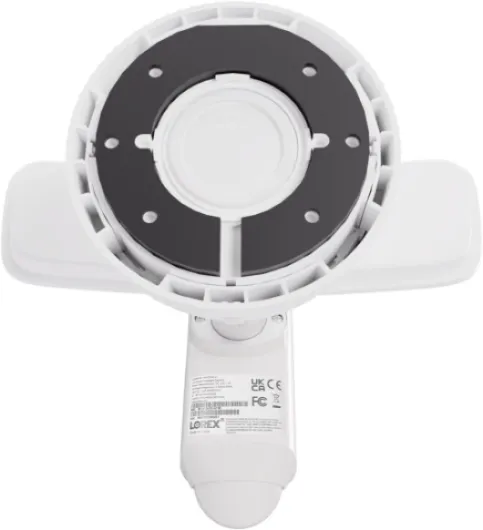
In the box you get the floodlight camera unit, a pre-installed 32 GB microSD card, a mounting plate, screws, anchors, wire caps, and some O-rings and small hardware. So basically, everything you need if you’re replacing an existing wired floodlight. There’s no extra hub or base station – it’s all WiFi and local storage. It runs on standard house wiring (hardwired, 40W), so this is not a plug-into-an-outlet type of camera.
Spec-wise, it’s a 2K (4 MP) camera, 15 fps, with a 122° viewing angle. That angle is wide enough to cover a driveway and front yard without giving you the weird fish-eye distortion you see on some cheaper cams. Night vision comes in two flavors: colour night vision when the lights or ambient light are decent, and IR black-and-white when it’s fully dark. The unit is IP65 waterproof, so it’s meant to live outside and deal with rain and snow. Lorex claims it’s fine in rough weather; user reviews mention using it in very cold temps, which is good if you’re somewhere that gets proper winters.
On the smart side, it connects over Wi-Fi and uses the Lorex app (Lorex Connect / Lorex Home depending on region) for live view, playback, and settings. You get smart motion detection for people, vehicles, and animals, so you can filter out constant alerts from tree branches or shadows. There’s also a built-in siren and 2-way audio, so you can talk to whoever’s out there or trigger a loud noise if someone’s snooping around. It also integrates with Lorex NVR/Fusion systems, which is handy if you already have some Lorex cameras.
Overall, the feature set is pretty complete: local storage, 2K resolution, bright LEDs, motion detection categories, and 2-way talk. On paper, it checks most boxes you’d expect from a modern floodlight cam. The real story is how it behaves in daily use, and that’s where there are some clear pros and a couple of annoying quirks, especially around motion detection distance and app polish.
Does it actually make your place feel more secure?
As a security tool, the combo of bright lights, camera, and 2-way talk works pretty well in practice. When someone walks up my driveway at night, the lights kick on, the camera records, and I get a notification on my phone. Being able to open the app and say something through the speaker is handy. The audio quality is okay – you can understand people clearly enough, and they can hear you, but it’s not hi-fi. There’s a bit of delay, but that’s normal for WiFi cameras.
The siren is a nice extra. I don’t use it automatically because I don’t want to annoy neighbours every time a raccoon walks by, but it’s there in the app if you want to tap it when you see someone lurking. As a deterrent, the visible floodlight plus the obvious camera lens already do a lot. Most people look straight at it when they notice it, which is exactly what you want. The presence effect is real – even delivery drivers seem more careful with packages when they see the camera staring at them.
The smart motion types (person/vehicle/animal) help cut down on junk alerts. When I limited alerts to people and vehicles, the number of notifications dropped a lot compared to a basic motion cam I used before. It’s not perfect – sometimes a big dog might get tagged as a person, or a person at the edge of the frame might not trigger right away – but generally, it focuses on the stuff that matters. If you want super fine control over exact motion zones and sensitivity, you’ll probably spend some time experimenting.
Overall, in day-to-day use, it gets the job done as a security floodlight camera. It lights up the area, records useful clips, and lets you check what happened without paying for cloud storage. It’s not the most precise or smartest system I’ve tried, but for a single-unit front or back yard setup, it’s more than enough to make you feel like you have a decent handle on what’s happening outside your house.
Pros
- Sharp 2K video with good detail day and night, plus decent 10 m night vision
- Local microSD storage included (32 GB) with no mandatory subscription fees
- Bright, adjustable LED floodlights and solid IP65 weather-resistant build
Cons
- Motion detection distance and consistency can be underwhelming if you expect long-range coverage
- App is functional but less polished and intuitive than some big-name competitors
Conclusion
Editor's rating
If you want a floodlight camera that records locally, has sharp 2K video, and doesn’t lock you into a monthly plan, this Lorex 2K WiFi Floodlight Camera is a solid pick. The video quality is clearly better than basic 1080p units, the LEDs are strong enough to properly light up a driveway or backyard, and the IP65 build feels ready for real weather. The included 32 GB microSD is a nice touch – you can literally mount it, connect it, and have recordings without spending extra.
Where it falls short is mostly in motion detection range and app smoothness. Up close, detection is fine and the smart person/vehicle/animal filtering keeps the worst of the false alerts under control. But if you expect perfect, long-range detection or super refined motion zones, you might get frustrated. The app is usable but not the most intuitive compared to Ring or Google’s stuff. So, if you’re very picky about software or want the most polished ecosystem, look elsewhere.
I’d recommend this to people who: don’t want a subscription, already have or plan to build a Lorex system, and care more about good image quality and solid hardware than app cosmetics. If you’re a tech beginner who just wants something plug-and-play with the smoothest possible app and don’t mind paying a monthly fee, then a Ring or Nest floodlight might suit you better. For everyone else who’s okay with tweaking settings a bit, this Lorex camera gives you a good balance of performance, control, and long-term cost.