
Summary
Editor's rating
Is it worth the money compared to better-known brands?
Plastic dome design that looks okay and doesn’t scream “spy gadget”
No battery, just a simple wired setup (for better and for worse)
Build quality and long-term feel
Image quality, tracking, and night vision: how it behaves day to day
What you actually get with this camera
As a baby/pet monitor and security cam, does it actually help?
Pros
- Dual-lens design gives both wide overview and detailed PTZ view from a single camera
- 2K image quality with decent color night vision and clear IR in full darkness
- Good value for money considering PTZ, AI tracking, two-way audio, and dual-band WiFi
Cons
- App feels a bit clunky and less polished than bigger brands
- Wired-only power limits placement and no battery backup for outages

Specifications
View full product page →| Brand | VSTARCAM |
A budget dual-lens camera that actually does the job
I’ve been using this VSTARCAM CS2DR indoors for a bit now, mainly as a baby/pet cam in the living room and to keep an eye on the front door area. I didn’t know the brand at all before buying it, so I went in thinking “probably another random Chinese camera, let’s see if it’s trash or decent.” Spoiler: it’s not trash, but it’s not perfect either.
The first thing that surprised me is how much stuff they packed into it for the price: dual lenses, 360° PTZ, AI tracking, color night vision, 2.4G/5G WiFi, two-way audio. On paper it looks like one of those overpromised listings, so I paid attention to what actually works and what’s just buzzwords. Most of it works, just not always as cleanly as the product page makes it sound.
I mainly used it ceiling-mounted in the living room pointing down, plus some testing on a shelf at window height. I connected it to both 2.4 GHz and 5 GHz WiFi to see if there was a big difference, and I tried the SD card recording and the app notifications. I also compared it with a basic 1080p indoor cam I already own from a better-known brand, just to have a reference point.
If you’re expecting something flawless with premium polish, this isn’t it. If you want a camera that covers a big area, lets you talk to whoever’s at home, and records decently without costing as much as the big brands, then it starts to make sense. I’ll break down where it’s solid and where it’s a bit “meh but it works.”
Is it worth the money compared to better-known brands?
Price-wise, this sits in that sweet spot between the ultra-cheap no-name cameras and the better-known brands like TP-Link, Ezviz, or Eufy. For the money, you’re getting dual lenses, 2K resolution, PTZ, AI tracking, dual-band WiFi, and two-way audio. If you tried to replicate that setup with two separate branded 2K cameras, you’d likely pay quite a bit more. So from a pure feature-per-pound point of view, it’s good value.
Where you feel the “unknown brand” side is mainly in the app and ecosystem. The app works, but it’s not as polished or as nicely translated as the big players. The menus are a bit clunky, some options are not super clear, and you don’t get the same tight integration with other smart home stuff unless you’re ready to fiddle with it. If you just want a standalone camera and you’re okay living in their app, it’s fine. If you’re building a whole smart home around a specific ecosystem, you might prefer sticking to a brand that plays nicer with your existing gear.
Compared to my older 1080p cam from a big brand, image quality and coverage on the VSTARCAM are better, no question. But the other cam’s app feels smoother and the notifications are slightly more reliable. So it’s a trade-off: more hardware for your money vs. better software and long-term support. Given the 12-month warranty and that it’s been stable for me so far, I think the risk is acceptable if you’re budget-conscious.
If you just need one solid indoor cam to watch a large room, kids, or pets and you don’t care about brand prestige, this is good value. If you’re picky about app experience and want something your less tech-savvy family members can use without questions, you might want to pay more for a more established brand. Personally, for a secondary camera or first try at home monitoring, I think the price-to-features ratio is hard to beat.
Plastic dome design that looks okay and doesn’t scream “spy gadget”
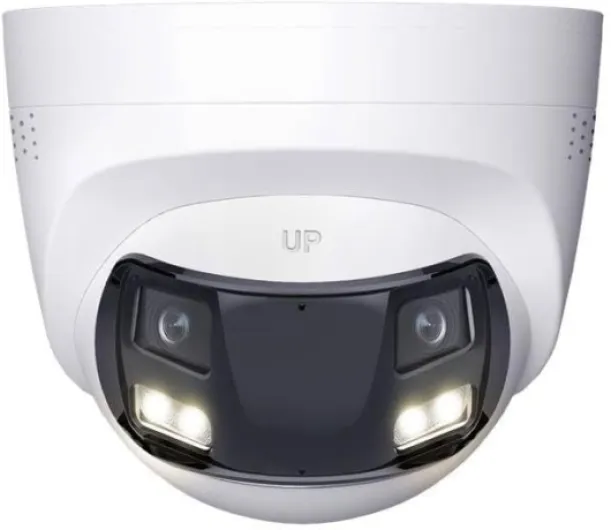
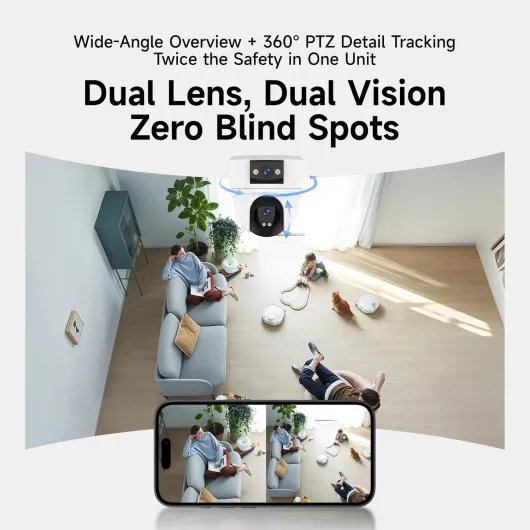
Design-wise, the CS2DR is pretty standard for an indoor dome camera: white plastic body, rounded head, and the two lenses stacked in front. It’s not exactly pretty, but it doesn’t look cheap to the point where you’d be embarrassed to put it in the living room. It blends in with other white plastic stuff like routers or smart speakers. If you want something super discreet, this isn’t tiny, but it’s not huge either – roughly 12 x 12 x 18 cm, so about the size of a big coffee mug with a neck.
The camera is meant to be mounted on the ceiling or wall with screws, but I also tested it just sitting on a shelf. On a shelf, it works, but when you use the PTZ and it rotates quickly, you can see the body shift slightly if the surface isn’t perfectly flat. Ceiling mount is clearly the intended use: once it’s screwed in, it feels much more stable, and the 360° rotation actually makes sense because it can see the entire room from above.
At night, the little LEDs are visible but not blinding. If you’re using it as a baby monitor, it might catch the baby’s attention if they’re older and curious, but it’s not like a bright lamp. The front looks a bit “robot eye” with the dual lenses, so if you’re paranoid about feeling watched, you’ll definitely notice it. For me it’s fine, it just looks like any other indoor cam.
The only thing that annoyed me slightly is the cable management. The power cable exits from the back and if you ceiling-mount it, you end up with a cable running down the wall unless you hide it in a trunking strip. Not a deal-breaker, just something to know. There’s no Ethernet port exposed for PoE or wired network, so you’re stuck with WiFi and the power cable. Overall, the design is practical, a bit basic, but it fits a normal home without looking ridiculous.
No battery, just a simple wired setup (for better and for worse)
There’s no battery in this thing at all, it’s fully wired for power. Some people will like that, some will hate it. Personally, for an indoor camera that’s meant to run 24/7, I prefer a wired setup. At least I don’t have to remember to charge yet another device. Once it’s plugged in behind a shelf or near the ceiling, you just forget about it and it keeps running.
The downside is obviously placement. You need a power outlet nearby, especially if you want to ceiling-mount it. If your ideal spot is in the middle of the ceiling with no plug around, you’re either running a long cable along the wall or calling an electrician to add an outlet. In my case, I had a plug about 1.5m down the wall, so I just used some cheap cable trunking to hide the wire. Not pretty, but acceptable.
Because there’s no battery backup, if the power goes out, the camera is dead. It doesn’t reconnect to some backup mode or anything. Once power comes back on, it reboots and reconnects to WiFi after about a minute or so. During my tests, after cutting power at the socket, the cam came back online automatically without me having to touch it, which is the minimum I expect. But if you live in an area with frequent outages and you care about continuous recording, you’ll need a UPS on the plug.
So yeah, not much to say about “battery life” because there is none. If you want a camera you can move around freely or use occasionally without a cable, this is not the product. If you want something that stays in one spot and just works when powered, a wired model like this makes sense. You trade flexibility for reliability. For a fixed indoor security or baby cam, I’m okay with that.
Build quality and long-term feel
The camera is clearly plastic-heavy, but that doesn’t automatically mean it’s fragile. The shell feels reasonably solid, no creaking when you twist it a bit, and the PTZ head doesn’t wobble like crazy. I wouldn’t want to drop it from a high shelf onto a hard floor, but for normal indoor use – mounted or on a piece of furniture – it feels fine. The motors inside for the pan/tilt movement sound like standard cheap PTZ motors: a light whirring noise, not silent but not loud enough to be annoying in a living room.
I used it daily for a couple of weeks, with quite a lot of PTZ movement because I was playing with the app and the tracking. No obvious play or looseness developed, and the camera still returned to the same positions without drifting. That’s usually where cheaper PTZ cams start to feel sketchy over time, when they stop pointing exactly where you think they are. Hard to judge long-term durability after only a short period, but so far nothing concerning.
The heat management is okay. After several hours of continuous streaming at 2K, the body is warm to the touch but never hot. That’s important if you’re leaving it running 24/7 in a kid’s room or near curtains. I didn’t see any glitches or reboots due to overheating, which I’ve had before with a super cheap no-name cam that basically cooked itself.
Officially, they mention outdoor use in the listing, but I’d be careful with that. There’s no clear IP rating, and the build doesn’t look truly weatherproof. I wouldn’t leave it fully exposed outside. Maybe under a deep porch or behind a window, okay, but not in the rain. For indoor use, though, the build quality is decent: it feels like something that should last a while if you don’t abuse it. Again, not premium, but not flimsy junk either.
Image quality, tracking, and night vision: how it behaves day to day
In terms of pure image quality, it’s honestly pretty solid for the price. The 2K resolution is clearly sharper than my old 1080p indoor cam. You can read text on a t-shirt from across the room and actually recognise faces, not just guess. During the day, colors look a bit on the cool side, but nothing dramatic. The wide lens gives you a nice full-room view, and the PTZ lens lets you zoom in without everything turning into mush. It’s not as clean as a high-end brand, but for a budget cam it gets the job done.
Night vision was where I was a bit skeptical, especially with the “color night vision” claim. In practice, if there is some ambient light (street light through a window, LED from a TV, etc.), you do get a usable color image. If the room is completely dark, it switches to classic IR black-and-white. That’s normal. The IR range is decent for a medium-sized room: I could see the whole 5m x 4m living room clearly. Faces are still recognisable, which is what matters for security or checking on kids.
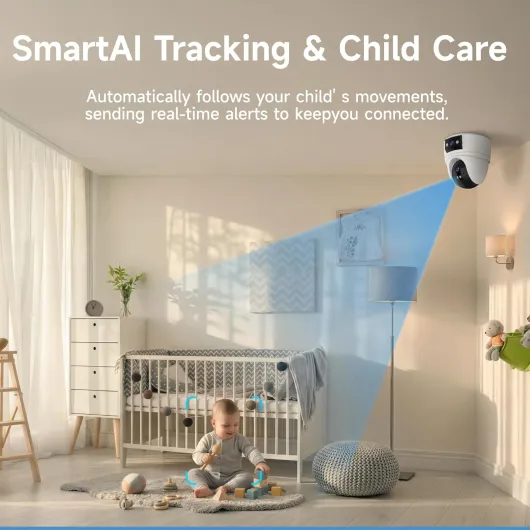
The AI tracking is hit and miss but generally okay. When my kid runs across the room, the PTZ lens follows her about 80% of the time. Sometimes it’s a bit slow and over-rotates or loses her when she goes behind furniture, which is expected. For pets it’s similar: my dog walking around gets followed, but fast movement can confuse it a bit. Motion detection notifications on the app are fairly quick – usually a few seconds delay – but if your WiFi is weak, the delay can be longer.
Streaming is smoother on 5 GHz WiFi in my experience. On 2.4 GHz in a crowded network, I had a couple of short buffering pauses when I was away from home on mobile data. Not catastrophic, but noticeable. With 5 GHz, it stayed more stable and the 2K stream didn’t stutter much. Overall, performance is good enough for daily home use: you can check in on the house, talk through the camera, and review clips without wanting to throw your phone out the window. Just don’t expect pro-level tracking or perfectly instant alerts.

What you actually get with this camera
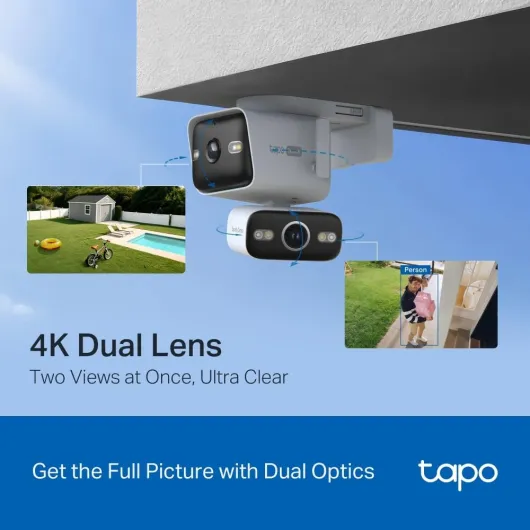
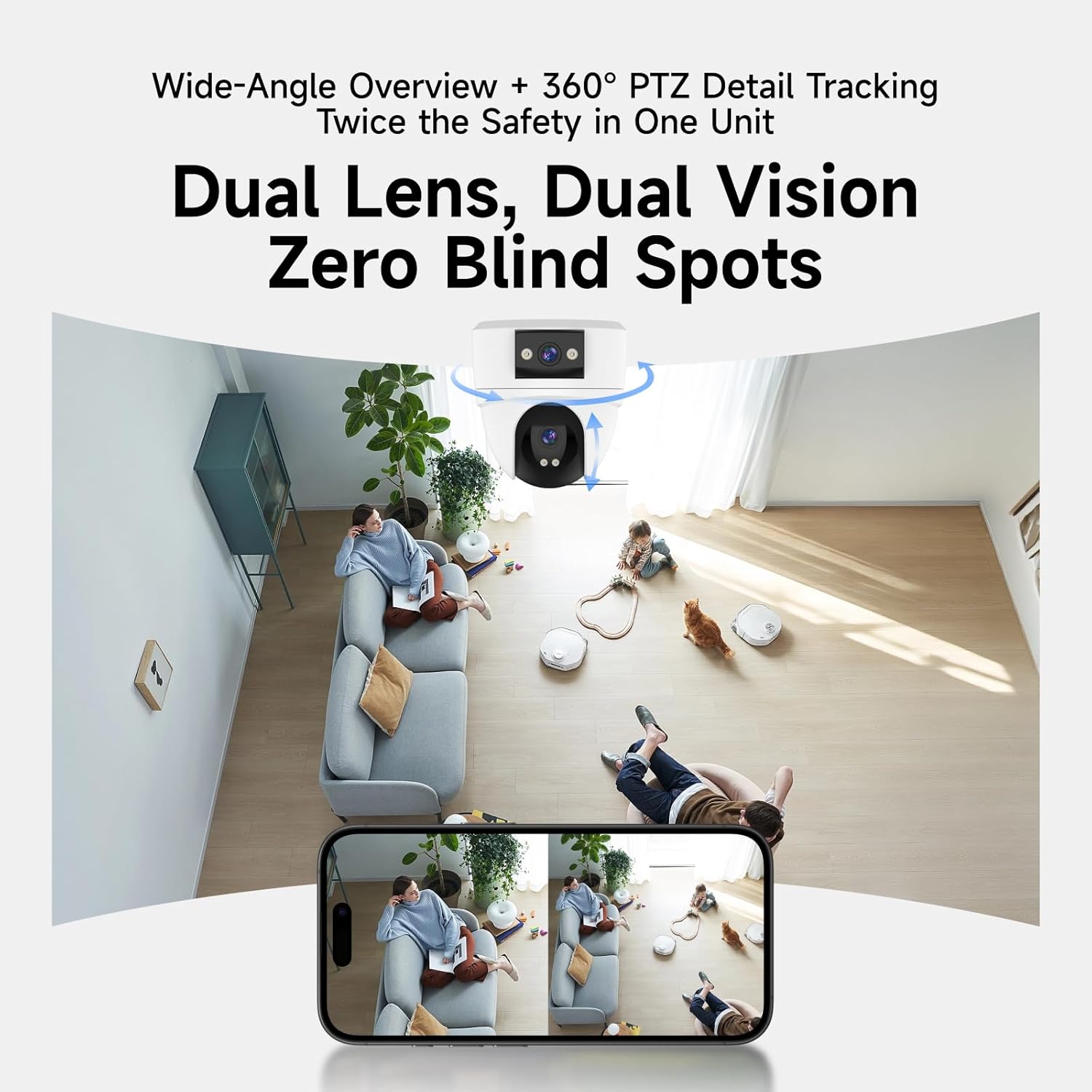
On paper, the CS2DR is sold as a 6MP / 2K dual-lens indoor camera with PTZ, AI tracking and color night vision. In practice, the main thing that stands out is the dual-lens setup: you’ve got one wide lens that gives you an overview of the whole room, and a second one that moves (pan/tilt) for the close-up view. The idea is that instead of buying two cameras, this one unit gives you both the big picture and zoomed-in detail.
In the app, you basically see two views: a fixed wide shot and the PTZ shot you can move around. It’s actually pretty handy if you’ve got kids running around and you want to see both the whole room and a specific area, like the cot or sofa. It’s not perfectly seamless – the app UI feels a bit clunky at first – but after a couple of days I got used to it. It’s more practical than having two separate cheap cameras stuck in different corners.
The camera supports up to 128 GB microSD (card not included, despite one review saying they got 32 GB – mine had none), and also offers cloud storage. I didn’t bother with the cloud because I’m not a fan of ongoing fees and I prefer local recording, so I shoved in a 64 GB card I already had. Loop recording worked fine: it overwrites oldest clips once it’s full. For a normal home, that’s enough to keep a few days of footage, depending on how much motion you have.
Overall, the product is basically: one compact dome-style camera that tries to replace two normal indoor cams, with app control, motion alerts, and two-way audio. If that’s the use case you have – big living room, kids’ room, maybe an open-plan area – it makes sense. If you just want to watch a single door or a small hallway, this is honestly a bit overkill and a simpler 1080p cam would do the job.
As a baby/pet monitor and security cam, does it actually help?
Using it as a baby monitor, it does the job. I set it up in the corner of the nursery, ceiling-mounted, with the wide lens covering the whole room and the PTZ focused on the cot. The two-way audio is handy: I could talk to my daughter when she started fussing, and the mic picked up crying and normal room noises well. There’s a tiny delay, but nothing crazy. Not as smooth as a dedicated baby monitor, but you get way more features (recording, remote access, etc.).
For pets, it’s actually pretty fun and practical. I left it in the living room while I was at work and checked in on the dog from time to time. The camera tracked him fairly well when he moved around, and I used the speaker to shout at him when he tried to climb on the sofa. He looked confused but it worked – he jumped off. The sound from the speaker isn’t hi-fi, but it’s loud enough to get attention. The mic picks up barking easily, so you can see when they’re going crazy.
As a basic home security camera, it’s decent. You get push notifications for motion, you can open the app and see what’s going on, and you have recordings on the SD card if something happens. The wide coverage is a big plus here: from a central spot, it sees pretty much the entire ground floor in an open-plan layout. Compared to a single fixed 1080p cam, it clearly covers more and gives better detail. Compared to a full-blown multi-camera system, obviously it’s limited, but that’s not the same price range.
Where it falls a bit short is the app polish and false alerts. Sometimes you get alerts for light changes (clouds, TV flicker) or minor movements that don’t matter. You can tweak sensitivity, but it takes a bit of trial and error. Also, the app interface feels a bit rough compared to bigger brands – it works, but it’s not super intuitive from day one. Once set up, though, the camera does what you expect: it lets you see and hear what’s going on and react if needed. For a cheap “all-in-one” indoor eye, it’s effective enough.
Pros
- Dual-lens design gives both wide overview and detailed PTZ view from a single camera
- 2K image quality with decent color night vision and clear IR in full darkness
- Good value for money considering PTZ, AI tracking, two-way audio, and dual-band WiFi
Cons
- App feels a bit clunky and less polished than bigger brands
- Wired-only power limits placement and no battery backup for outages
Conclusion
Editor's rating
After using the VSTARCAM CS2DR daily, my takeaway is pretty simple: it’s a feature-packed indoor camera that covers a lot of ground for the price, with a few rough edges mostly on the software side. The dual-lens setup actually makes sense in a real home: one view for the whole room, one PTZ lens you can steer where you want. Image quality is clearly better than basic 1080p cams, both during the day and at night. Color night vision works as long as there’s a bit of ambient light, and classic IR kicks in when it’s pitch black.
Two-way audio, motion alerts, AI tracking, and dual-band WiFi all do their job. Not perfectly, but well enough that you can monitor kids, pets, or your living room without stressing. The main trade-offs are the slightly clunky app, the fact that it’s an unknown brand, and the wired-only power. If you’re expecting Apple-level polish, you’ll be disappointed. If you just want something that records reliably, lets you check in remotely, and doesn’t cost a fortune, it’s a good fit.
I’d recommend it to people who want one camera to cover a large indoor area, or who want a flexible baby/pet cam with recording. If you already invested heavily in a specific smart home brand and care a lot about app experience and integrations, you might want to look at more established options. For everyone else, especially on a budget, it’s a pretty solid piece of kit that gets the job done without too much fuss.