
Summary
Editor's rating
Value for money: where it shines and where it cuts corners
Small, plasticky, but easy to place almost anywhere
Build quality, long-term use and reliability
Image quality, night vision and motion detection: how it really behaves
What the Tapo C110 actually offers in real life
As a baby/pet monitor and security cam, does it actually help?
Pros
- 2K image quality with clear day and night footage for the price
- Local microSD recording works well without needing a cloud subscription
- Easy setup and stable Wi‑Fi connection with a simple, usable app
Cons
- Speaker and built-in alarm are fairly quiet and not very impressive
- Cheap plastic build and effectively indoor-only despite IP66 mention

Specifications
View full product page →| Brand | Tapo |
A cheap indoor cam that actually lets you skip the subscription
I’ve been using the Tapo C110 for a few weeks now as a simple indoor camera at home, mainly to keep an eye on the front room and the dog when I’m out. I bought it because I was fed up with brands that quietly push you into paying for cloud storage with ads and blocked features. On paper, this one offers 2K video, night vision, motion alerts and local SD card recording, for the price of a takeaway.
In day-to-day use, the main thing that stands out is how simple it is to live with. Plug it in, add it in the Tapo app, set a few motion zones, and that’s it. No hub, no weird pairing dances, it just connects to Wi‑Fi and stays online. The app isn’t fancy, but I’d rather have a basic app that works than a flashy one that crashes every two days.
I’ve tried other budget cameras before (Yi, IMOU, random Amazon brands) and the pattern is always the same: they start fine, then updates bring ads, forced cloud pop-ups, or things break. With the C110, the cloud option is there (Tapo Care), but the camera works fine without it. You stick in a microSD card and you’re done. That was the main selling point for me: local storage without being nagged every 5 minutes.
It’s not perfect though. The speaker for the alarm is a bit weak, the plastic body feels cheap, and it’s clearly meant for indoor use even if some listings mention IP66. But for the price, and given how stable it’s been on Wi‑Fi and how clear the image is, it’s honestly a pretty solid little cam if you just want something that works and don’t want to sign up for yet another subscription.
Value for money: where it shines and where it cuts corners
From a value point of view, the C110 is hard to complain about. For roughly the cost of a cheap dinner, you get 2K video, night vision, motion alerts and local SD recording. The key for me is that local storage works properly without forcing you into a subscription. You can add Tapo Care if you want cloud backups and a few extra features, but the camera is fully usable without it. That’s a big plus compared to brands that nag you non-stop.
Where they clearly saved money is in the build quality and audio side. The plastic shell is nothing special, and the speaker used for 2‑way audio and the built-in siren is on the weak side. If you were hoping to scare someone away with a loud alarm, this is not it. The microphone is okay for hearing what’s going on, but you won’t get crystal-clear conversations. It’s fine for quick check-ins (“hey, leave the sofa alone” to the dog, or “I’ll be home soon”), but that’s it.
Compared to slightly pricier indoor cams from bigger brands, you’re giving up a bit of polish in the app and maybe some advanced AI detection features. But if you just want something that records when there’s motion and lets you see what’s happening, this one hits the basics very well. The Tapo app is straightforward, and the camera integrates nicely if you already have TP-Link gear or smart plugs.
Overall, I’d say the C110 offers good value for money if your expectations are realistic: solid image quality, decent night vision, reliable motion alerts, and no forced subscription. If you want pan/tilt, built-in battery, or a tougher outdoor build, you’ll have to spend more or look at other models. But as a simple indoor cam for a flat, pets, kids, or a hobby corner like a 3D printer, it’s an easy and relatively cheap option that does what it says.
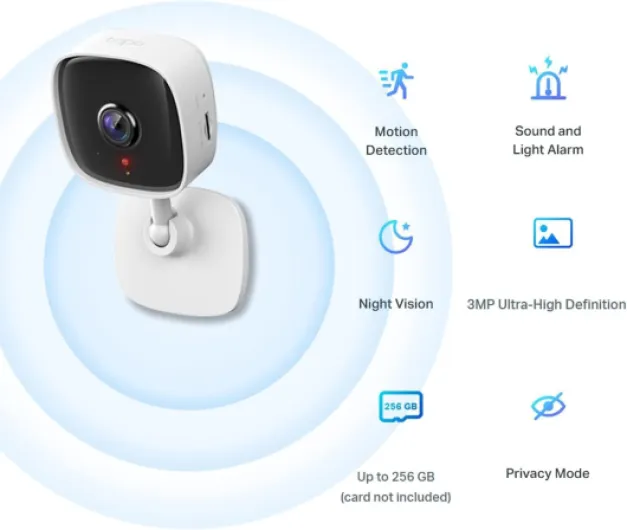
Small, plasticky, but easy to place almost anywhere
The design of the Tapo C110 is very basic: white plastic body, square camera head on a small stand, and a cable sticking out the back. If you’ve seen any cheap indoor cam on Amazon, you’ve basically seen this one. It’s light (around 70 g), which makes it easy to mount on walls or ceilings with the included plate and screws, but you also feel that it’s not exactly premium hardware. It looks fine on a shelf, not stylish, not ugly, just there.
The stand is a simple hinge that lets you tilt and rotate the camera head to aim it. It holds its position well enough; I didn’t have issues with it sagging over time. Because it’s so small, you can tuck it behind a plant, on top of a wardrobe, or next to a TV without it drawing much attention. That’s handy if you don’t want something that screams “security camera” in the middle of your living room.
One thing to be aware of: the cable is fairly thin and white, and the power adapter is not tiny. If you’re fussy about cable management, you’ll probably end up using clips or trunking to hide it. Also, despite some specs mentioning IP66, I’d treat this as an indoor-only device. The housing doesn’t look sealed, and I wouldn’t trust it in a damp or exposed outdoor spot. I used it in a normal living room and near a 3D printer in a workshop area, and it handled dust and normal room temperatures fine.
In short, the design is practical rather than pretty. It’s light, compact, and simple to mount, but the plastic look and feel are clearly budget level. If you care about aesthetics, you might call it “meh but acceptable”. If you only care about function, you’ll probably forget what it looks like after the first day.
Build quality, long-term use and reliability
The C110 is clearly built to hit a low price, so the first impression is “light plastic box with a lens”. That said, after a few weeks of being plugged in 24/7, I haven’t had any overheating, random reboots, or weird noises. It stays slightly warm to the touch, which is normal for a small powered device. The hinge for the stand still feels tight and hasn’t loosened, even after repositioning it several times to find the best angle.
In terms of reliability, the Wi‑Fi connection has been stable. Earlier cheap cameras I had would drop off the network every few days and need a reboot. This one just sits there and keeps recording to the SD card. I tested it with power cuts: when power comes back, it reconnects by itself and resumes recording without me having to touch anything. That’s the kind of boring reliability you actually want from a camera.
I wouldn’t treat the IP66 mention as gospel. The overall construction doesn’t feel like something meant to live outside in the rain or freezing conditions. For indoor use in a normal home (living room, hallway, home office, even a garage that doesn’t get soaked), it’s fine. I had one unit in a slightly dusty workshop area, and it handled that without issues. Just don’t expect it to survive being sprayed or left in direct sun behind a window all day for years.
Long term, the bigger question is software support. Tapo/TP-Link is a known brand, so I’m a bit more confident than with random white-label cameras. The app gets updates, and existing users seem happy over time. Still, at this price, if it lasts a couple of years without trouble, I’d call that decent. You’re not buying a lifetime device here; you’re buying a cheap, functional camera that should handle daily indoor use without falling apart.
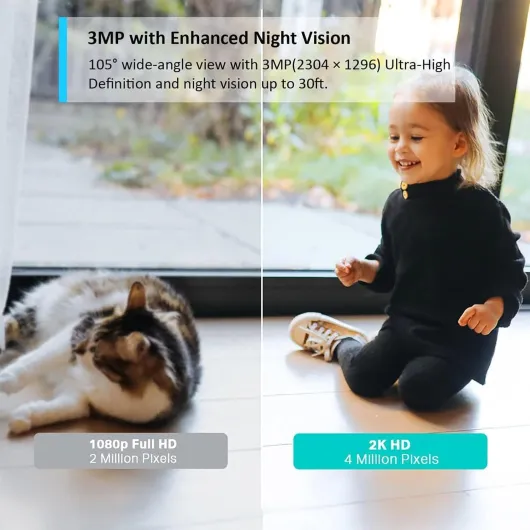
Image quality, night vision and motion detection: how it really behaves
In terms of pure performance, the C110 does better than I expected for the price. The 2K resolution is actually visible in real use: during the day, the image is sharp enough to read small labels on boxes and see facial expressions clearly. Colors are decent, not TV-level, but good enough to see what’s happening without guessing. There’s a bit of compression when your Wi‑Fi signal isn’t great, but it stays watchable. Compared to old 1080p Yi and random no-name cams I had, this one clearly gives a cleaner image when you zoom in.
Night vision is also pretty solid. The infrared range is around 30 feet, and in a normal living room or hallway, you can see the whole scene in black and white without much noise. Some users mention “night color” under street lights: that’s more about the sensor being sensitive enough to work with low ambient light. If there’s a lamp outside or dim lighting in the room, you still get color video. In total darkness, it flips to IR and stays usable. I checked on the dog and on long 3D prints at 3 a.m., and I had no trouble seeing what was going on.
Motion detection is where budget cams often get annoying, but the C110 is relatively manageable. You can set activity zones in the app, so it doesn’t trigger on everything. Once I limited the zone to just the door area and part of the sofa, the number of useless alerts dropped a lot. The AI detection (person, pet, etc.) is not perfect, but it’s good enough to avoid constant spam. You’ll still get the odd false alert if light changes quickly or if something like curtains moves, but it’s not crazy.
Streaming performance is stable. On my Wi‑Fi, the live view loads in a couple of seconds. Even at the edge of coverage, it didn’t drop constantly like some other cheap cams I’ve had. There’s a small delay (1–2 seconds), which is normal, but nothing that makes it unusable. For watching a room, a baby, or a printer, that delay is fine. For real-time conversations, you notice it a bit, but it’s still workable.
What the Tapo C110 actually offers in real life
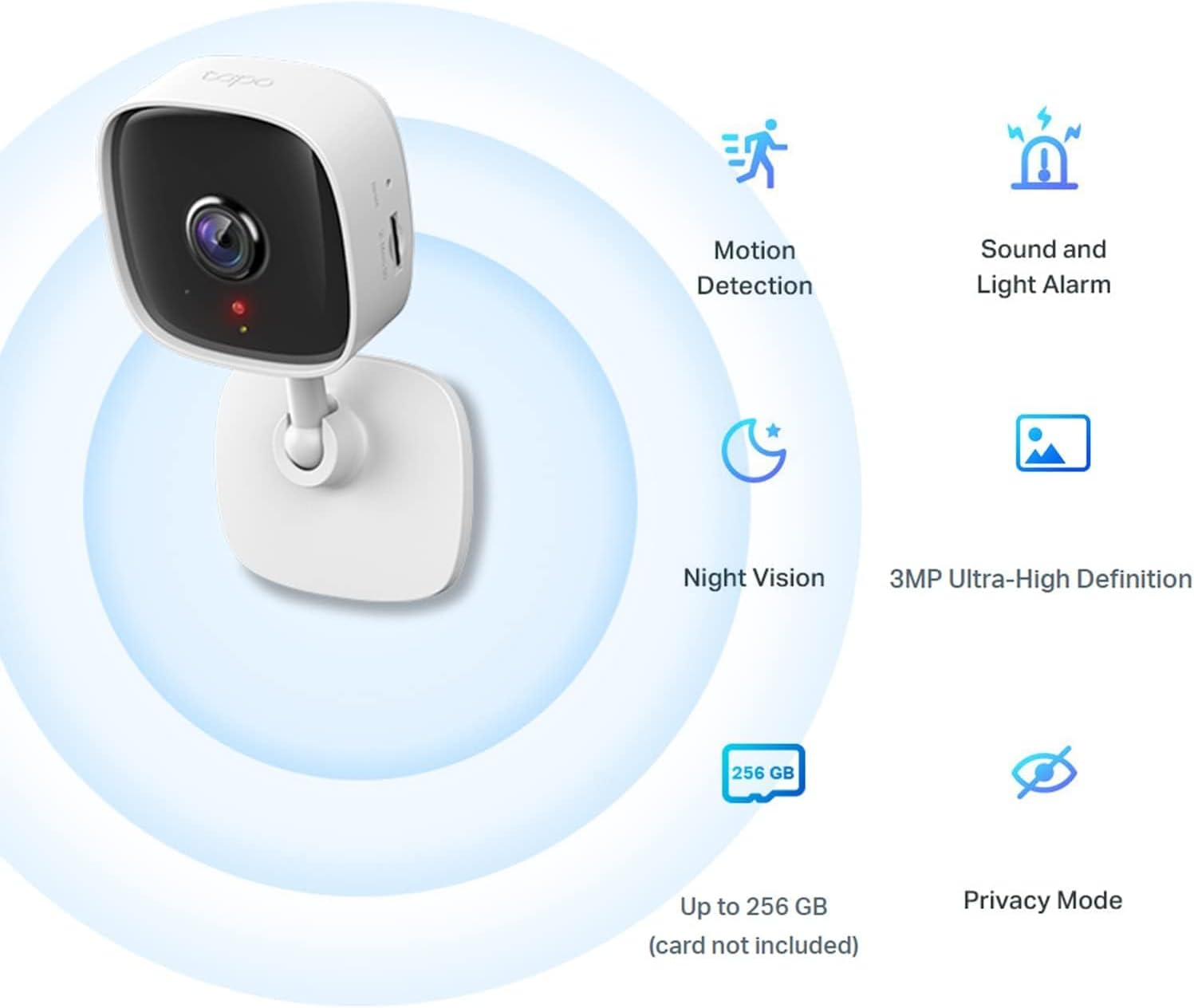
On paper, the Tapo C110 is a 2K (3MP) indoor Wi‑Fi camera with motion detection, night vision, 2‑way audio and support for microSD up to 128 GB. In practice, that means you plug it into a wall socket, connect it to your 2.4 GHz Wi‑Fi, and watch or record what’s happening in a room from your phone. It also works with Alexa and Google Assistant, so you can throw the video feed on a smart display if you have one.
The camera records in 2304 × 1296, which is sharper than the classic 1080p cams. You notice it when you zoom in on details like faces, text on boxes, or small movements (like a cat sneaking behind the sofa). The field of view is about 105°, so it covers a decent chunk of a room but it’s not a fisheye. It’s a fixed lens, no pan/tilt, so you have to think a bit about where you mount it. Once it’s up, you basically forget about it.
All the controls live inside the Tapo app: live view, recording playback (from SD or cloud), motion zones, notification settings, privacy mode, and the 2‑way audio. The app also lets you set a schedule for recording or alerts, which is handy if you don’t want motion notifications pinging your phone while you’re walking around at home in the evening. There’s also an option to trigger a siren from the camera. It’s more of a deterrent beep than a proper house alarm, but it’s there.
Overall, in daily use, the C110 behaves like a straightforward indoor cam. It doesn’t try to do smart home magic or pretend to be a full-blown alarm system. It just records, sends notifications when something moves, and lets you talk through it if you need to. If that’s what you’re after, it gets the job done without drama, as long as you’re fine with using the Tapo ecosystem.

As a baby/pet monitor and security cam, does it actually help?
As a practical tool, the C110 is effective enough that I actually use it daily, not just for testing. As a pet monitor, it does the job: I can check if the dog is on the sofa again or if the cat is doing something suspicious near the plants. The motion alerts help when I’m out; I get a ping when there’s movement during hours when nobody should be in that room. It’s not a full alarm system, but as a basic watchful eye, it’s fine.
As a baby or kid monitor, it works, but with some caveats. The image is sharp, and the night vision is good enough to see if a child is moving or standing up. The 2‑way audio lets you talk through the camera, which can be handy to calm a kid or tell them you’re coming. But the built-in speaker is not very loud, and there’s a bit of delay. For quick reassurance it’s okay, but I wouldn’t rely on it as the only baby monitoring solution if you want instant audio feedback like a classic audio baby monitor.
I also used it for a more “nerdy” purpose: keeping an eye on a 3D printer in another room. For that, it’s actually very handy. The 2K resolution lets you see the print head and the layer build-up clearly. When motion detection triggers at odd times, I know something probably went wrong with the print, and I can stop it before wasting a whole spool. In that context, the camera feels very useful and pays for itself quickly by saving failed prints.
As a security camera, it’s good for indoor coverage of doors, hallways, or a home office. You get motion clips on the SD card, and if you pay for Tapo Care you also get cloud backup, but I stuck to local storage. For a flat or small house, it’s enough to see who came in or what happened at a specific time. It’s not going to scare intruders with its alarm, but it gives you decent footage and notifications, which is honestly what most people need at this price point.
Pros
- 2K image quality with clear day and night footage for the price
- Local microSD recording works well without needing a cloud subscription
- Easy setup and stable Wi‑Fi connection with a simple, usable app
Cons
- Speaker and built-in alarm are fairly quiet and not very impressive
- Cheap plastic build and effectively indoor-only despite IP66 mention
Conclusion
Editor's rating
The Tapo C110 is a straightforward indoor camera that focuses on the basics: clear 2K image, decent night vision, motion alerts, and local SD storage without forcing you into a subscription. It’s not flashy, and the build is clearly budget, but in daily use it’s reliable and doesn’t bombard you with ads or cloud paywalls. The app is simple, the Wi‑Fi connection is stable, and setup takes just a few minutes. For watching pets, a baby’s room, an entrance, or even a 3D printer, it gets the job done without much fuss.
It’s not perfect. The speaker and alarm are a bit weak, the plastic design feels cheap, and despite some specs mentioning IP66, I’d treat it as indoor-only. The AI detection is decent but not magic, and if you want pan/tilt or full-blown alarm features, you’ll need to look at more expensive models. But for the price, it’s a solid option for anyone who wants a simple, always-on camera with local recording and basic smart features.
If you’re on a budget, don’t want another subscription, and just need a reliable indoor cam you can plug in and forget, the Tapo C110 is a good fit. If you’re picky about design, need louder audio, or want something for outdoors, you should probably skip this one and go for a higher-end or outdoor-specific model.