
Summary
Editor's rating
Is it worth the price, or should you go cheaper?
Big, obvious, and built like a proper outdoor camera
Outdoor use, build quality, and long‑term confidence
Day/night image quality, tracking, and how it behaves in real life
What this camera actually does, beyond the fancy name
Does it actually make your place more secure?
Pros
- Dual‑lens design gives wide overview and zoomed detail on one channel
- Good 4K daytime image quality and decent night performance with IR and spotlight
- Reliable auto tracking and person/vehicle/pet detection once tuned, with local storage and Home Assistant/NVR support
Cons
- Manual PTZ control is clumsy and no native patrol mode
- Long‑distance night detail and plates are limited, not a magic long‑range solution

Specifications
View full product page →| Brand | Reolink |
A PTZ camera that actually follows people (most of the time)
I’ve been running the Reolink TrackMix PoE outside my house for a few weeks, mainly to cover the driveway and front door. I already had a couple of fixed Reolink bullets, so I wanted something that could actually follow people and cars instead of just giving me a static shot. On paper this camera ticks a lot of boxes: 4K, dual lens, auto tracking, PoE, proper night vision, and no forced cloud subscription. So I was curious to see if it was just marketing or if it really changes day‑to‑day use.
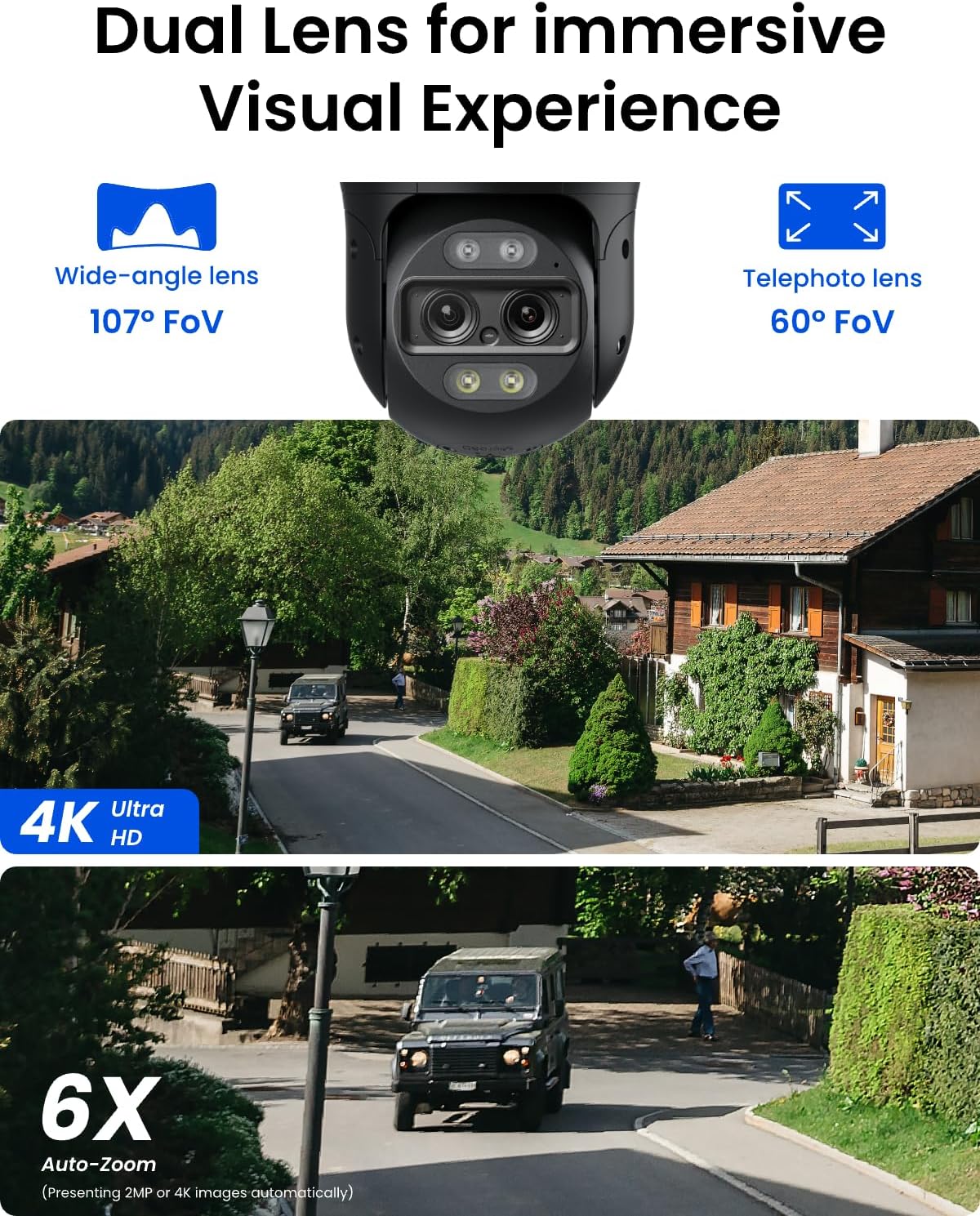
In practice, the first thing that stood out is the dual view: you see a wide shot and a zoomed shot at the same time in the app or in the Reolink client. For real use, like checking a car plate or seeing what exactly a courier is holding, that’s actually useful, not just a gimmick. The PTZ head moves quietly, the tracking kicks in fast enough, and it doesn’t freak out with every tree branch moving, once you tune the sensitivity.
It’s not perfect though. The tracking logic is a bit “step by step” and not smooth cinematic stuff, and manual PTZ control on the phone feels a bit clunky. Also, you really need to think about where you mount it, because the IR and the spotlight have limits, and it’s not magic at 30–40 meters. Picture is strong, but you still have physics.
Overall, from a normal user point of view, it’s a pretty solid security upgrade if you already have Ethernet outside or can run a cable. It’s not the cheapest Reolink, and there are a few annoyances, but for what it does—dual view, tracking, and local storage—it gets the job done and actually makes me check my cameras less because it follows the action by itself.
Is it worth the price, or should you go cheaper?
Price‑wise, the TrackMix PoE sits above the basic Reolink fixed 4K cams and closer to the more advanced PTZ range. It’s not dirt cheap, but it’s also not in the crazy professional PTZ price bracket. For what you pay, you’re getting dual lenses, 4K, tracking, spotlight, audio, and PoE, plus decent integration with NVRs, NAS, and Home Assistant. When you compare that to buying two separate cameras (one wide, one zoom) plus a separate light, it starts to look more reasonable.
Where it really gains points in value is the single NVR channel usage. Having two lenses but still only taking one channel is a big deal if you’re running an 8‑channel NVR and don’t want to burn two slots on one spot. Also, Reolink doesn’t force you into a paid cloud subscription. You can use an SD card, an NVR, or your own NAS. Over a few years, that saves a decent bit compared to brands that basically push you into monthly fees for basic features.
On the flip side, you should ask yourself if you really need PTZ and tracking. If you only want a static view of a door or a small garden, a cheaper 4K fixed Reolink will probably be enough and easier to place. The TrackMix really makes sense when you want to cover a larger area (driveway, yard, parking spot) and actually make use of the auto‑tracking and zoom. If you never touch the PTZ features and don’t care about the dual view, you’re paying for stuff you won’t use.
Overall, I’d call the value good but not crazy. It’s a solid purchase if you catch it on sale (which happens fairly often), especially if you already have Reolink gear or want local storage and Home Assistant integration. If you’re on a tight budget or only need basic coverage, I’d drop down to a simpler model. But for a main camera in a key spot, the price makes sense for what it brings.
Big, obvious, and built like a proper outdoor camera
Physically, this thing is not small. The dimensions (about 22.8 x 14.7 x 11 cm) don’t sound huge on paper, but once it’s on the wall, you notice it. For me, that’s a plus. As a deterrent, a visible PTZ head that moves and lights up is much more convincing than a tiny white dot under the eaves. The grey version I have looks a bit more “pro” than the usual glossy white domes. It doesn’t exactly blend into the wall, but that’s kind of the point for a security cam.
The body is a mix of metal and solid plastic. Nothing feels flimsy. When you grab it to mount it, there’s no creaking, and the joints where the dome meets the bracket feel tight. The PT motors are almost silent; you hear a soft hum if you’re standing right under it at night, but from inside the house with closed windows, I don’t hear anything when it pans. That’s nice because some cheap PTZs sound like a printer every time they move.
The mount is a standard wall mount plate with screw holes and a channel for the cable. You do need to plan cable routing: since it’s PoE, you’re running Ethernet, and if you want it neat, you’ll probably drill through the wall or use conduit. I ended up drilling straight behind the bracket so the cable disappears into the wall. There’s enough space under the body to tuck the connector, but if you’re picky, you’ll want a junction box or to hide the pigtail inside.
One thing to know: this is clearly designed for outdoor use but it doesn’t look like a discrete indoor cam at all. If you put this inside your living room, it’ll look like a mini CCTV station, not a home gadget. Also, because it can rotate almost all the way around, make sure you don’t mount it too close to walls or gutters that’ll block its view when it pans. Overall, design is practical and tough, more “installer gear” than “smart home toy”, which I liked.
Outdoor use, build quality, and long‑term confidence
I haven’t had it for years obviously, but after a few weeks outside in mixed weather (rain, some wind, temperature swings), the housing looks and feels solid. No condensation inside the dome, no weird noises from the motors, and no random reboots. The metal parts don’t flex, and the plastic doesn’t look cheap or brittle. It feels closer to small business CCTV gear than to the plastic Wi‑Fi cams you hang under a porch.
The PT mechanism is usually the weak point on cheaper PTZs, but here it seems well controlled. Movements are smooth and not jerky, and you don’t hear grinding or clicking when it hits the end of its travel. I played around with it more than usual the first week—constantly panning, zooming, switching presets—just to see if it would glitch, and it never lost position or started drifting. Auto tracking also kept working, so no sign of the motors getting confused or stuck.
Weather‑wise, I’ve had it in decent rain and some cold nights. The camera kept working fine, and the spotlight and IR both stayed bright. The cable connection area is reasonably protected if you mount it properly, but I’d still recommend either using a junction box or sealing the entry points if it’s fully exposed. PoE is a plus here: one cable for power and data reduces failure points compared to separate power supplies and adapters dangling in the wind.
Long‑term, I obviously can’t say after just weeks, but based on Reolink stuff I’ve owned for a couple of years (fixed bullets and domes), their hardware usually holds up okay outdoors. This one feels at least as solid as those, if not better. So while it’s not industrial‑grade, I’m reasonably confident it’ll handle normal residential outdoor use for several years without falling apart, as long as you don’t mount it in a place where it gets smashed by ladders or balls.
Day/night image quality, tracking, and how it behaves in real life
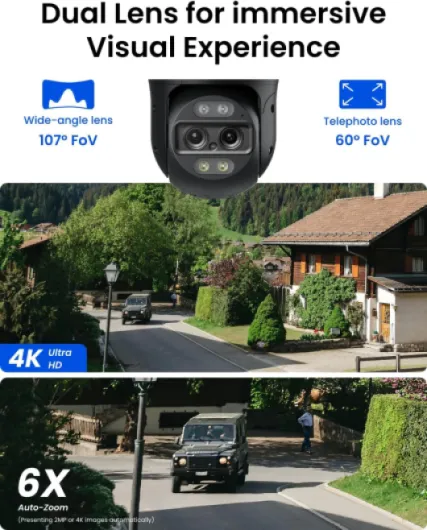
Image quality during the daytime is genuinely good for a consumer camera. The 4K stream is sharp, and the wide lens gives you a clean overview without too much distortion. The telephoto lens is where it gets useful: you can read number plates at a decent distance (in my case, across the driveway and part of the street) as long as the car isn’t flying by. Colors are natural enough, not oversaturated, and HDR does a decent job when the sun hits the scene. Compared to my older 1080p Reolink bullets, the extra detail is obvious when you zoom in on recordings.
At night, it depends on distance. Up close (say up to 10–15 meters), the IR and the spotlight do a solid job. Faces are clear, movement is easy to follow, and if you turn on the spotlight you get real color night vision, not that washed out greenish mess. Further out, you start to see the limits: there’s a bit of ghosting on moving subjects near the edge of the IR range, and plates at 25+ meters aren’t always readable if the car is moving. That’s fairly normal, but if you expect perfect plate shots at long distance in the dark, this isn’t a miracle device.
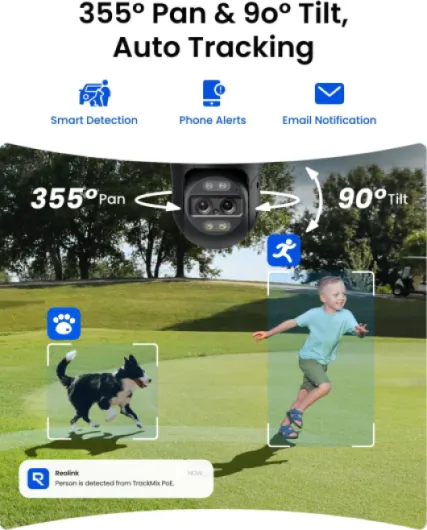
The auto‑tracking is one of the main selling points, and overall it works well, but with a certain style. It doesn’t constantly follow super smoothly; it tends to re‑center the target, then wait, then move again when the person or car drifts off center. So you end up with a sequence of small pans instead of one continuous follow. In recordings, it’s totally usable—you still see where the person goes—but if you’re expecting Hollywood‑style tracking, forget it. For people walking up the drive, delivery drivers, or a dog wandering in the garden, it does the job.
As for notifications and responsiveness, through my NVR and the Reolink app, alerts pop up quickly, usually within a couple of seconds of motion. The app lets you filter by person/vehicle/pet, which cuts down on useless alerts. Manual PTZ via on‑screen buttons works, but it’s not very precise; you tap, it moves a bit too far, you tap back, etc. There’s no support for PTZ joystick or keyboard shortcuts, which is a pity if you’re used to “real” CCTV control. So for automatic tracking and presets, performance is strong. For manual fine control, it’s usable but a bit clumsy.
What this camera actually does, beyond the fancy name
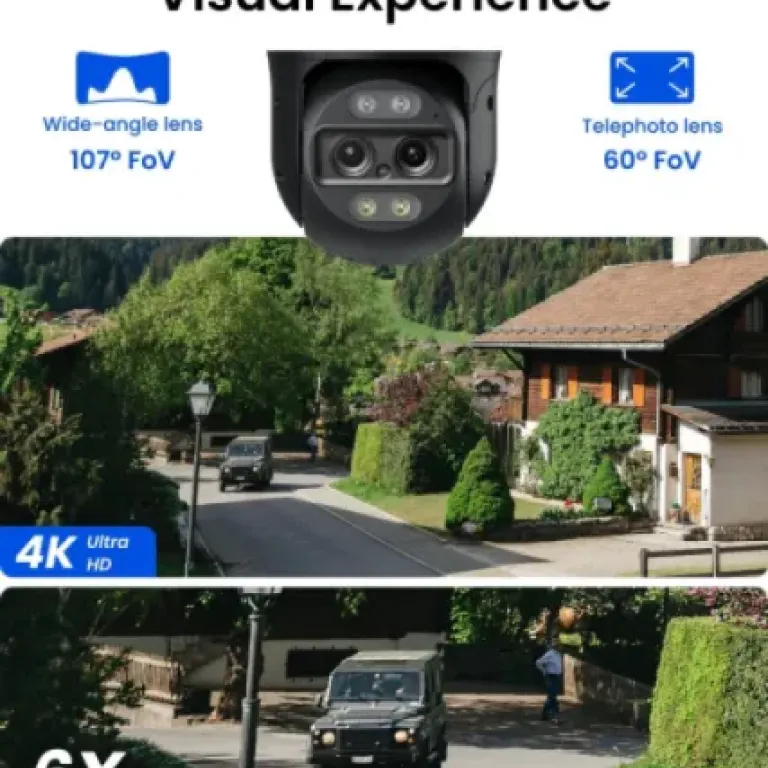
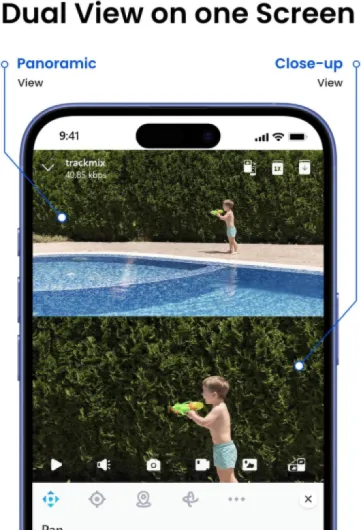
The TrackMix PoE is basically a dual‑lens PTZ camera. You’ve got one wide‑angle lens (2.8 mm) that shows the whole scene, and a telephoto lens (8 mm) that zooms in on what matters. In the app or Reolink desktop software, you see both feeds at once: a big wide view and a smaller zoomed view, or vice versa depending on how you set it up. That’s the main idea of this product: you don’t lose context when you zoom in.
Resolution‑wise, the main stream is 8MP (4K), and the tracking stream is Full HD. So for recording plates or faces at a reasonable distance, it’s clearly above the usual 1080p cameras. It records in MP4, works over Ethernet (PoE), and it can be used standalone with an SD card, with a Reolink NVR, or with third‑party stuff like Home Assistant and NAS. That last point matters if you don’t want to send everything to some random cloud. I personally run it with a Reolink NVR and also pulled the streams into Home Assistant just to test; both worked fine.
Feature list in real words: it can pan 355°, tilt 90°, has auto‑tracking for people/vehicles/pets, has color night vision thanks to a built‑in spotlight, and has a two‑way speaker/mic that is actually loud enough to shout at a courier. There’s also motion zones, alerts to your phone, and presets for positions and zoom levels. The only thing missing that I would expect on a PTZ is a built‑in “patrol” mode. You can fake it with Home Assistant or NVR rules, but out of the box there’s no simple “scan between these three points every X seconds” button.
So in short: it’s not just a slightly better fixed camera; it’s a feature‑packed PTZ that’s meant to be your main active camera in a area. If you only need a simple always‑on shot, this is probably overkill. But if you want something that follows movement, gives you detail and overview at the same time, and works well with local recording, that’s exactly what it’s built for.
Does it actually make your place more secure?
From a pure security standpoint, this camera does more than a basic fixed dome. The combination of a moving head, spotlight, and dual view means intruders are much more likely to notice it and change their behavior. When someone walks into my driveway at night, the spotlight kicks on, the head turns to follow them, and it’s very obvious they’re being watched. I’ve seen couriers look straight at it and adjust where they leave packages, which is exactly what I wanted: visible surveillance that changes how people act.
For evidence, the dual stream is genuinely useful. The wide lens keeps the whole scene, so you know where the person came from and where they went, while the zoomed stream gives you details like face, clothes, or car plate as long as they’re in a reasonable range. The nice thing is that it still only uses one channel on the Reolink NVR, so you’re not burning extra channels just for the second lens. When I reviewed some test clips (friends coming over, car in and out, dog in the yard), I always had at least one angle that was usable, which is more than I can say for some cheaper cameras.
The smart detection (person/vehicle/pet) works decently. It’s not perfect, but with the right zones and sensitivity, I cut down a lot of false alerts from trees and shadows. My dog triggers it reliably as a “pet” when she’s in the garden, which is what I wanted to check. Vehicles are detected fine when they enter the driveway, though random cars driving past on the street do set it off if I don’t mask that area. So you need to spend 20–30 minutes tweaking detection zones and thresholds, but once that’s done, it’s mostly quiet unless something relevant happens.
Where it falls a bit short is integrated deterrence intelligence. The camera can track and light up, but there’s no built‑in scenario like “if a person loiters for more than X seconds, play a warning message and send a special alert.” You can build that in Home Assistant or using NVR rules, but out of the box it’s fairly basic: track, light, record, notify. Still, for most people, that’s already a big step up from a dumb fixed cam that just records everything without focusing on the subject.
Pros
- Dual‑lens design gives wide overview and zoomed detail on one channel
- Good 4K daytime image quality and decent night performance with IR and spotlight
- Reliable auto tracking and person/vehicle/pet detection once tuned, with local storage and Home Assistant/NVR support
Cons
- Manual PTZ control is clumsy and no native patrol mode
- Long‑distance night detail and plates are limited, not a magic long‑range solution
Conclusion
Editor's rating
After actually using the Reolink TrackMix PoE day‑to‑day, I’d say it’s a pretty solid PTZ security camera for someone who wants more than a static view. The dual‑lens setup with wide and zoomed views on the same screen is genuinely useful, not just a fancy spec. Auto tracking works well enough to keep people, cars, and pets in frame, and the 4K resolution gives you detail that cheaper 1080p cams just can’t match, especially during the day. Night performance is good within realistic distances, and the spotlight plus two‑way audio add a real deterrent effect.
It’s not perfect. Manual PTZ control is a bit clunky, there’s no built‑in patrol mode, and long‑distance night detail still has limits. It’s also overkill if you only need a simple static camera for a small area. But if you have PoE available, want local storage instead of cloud dependence, and like the idea of a camera that actively follows what’s happening, it’s a strong option. I’d recommend it for driveways, back gardens, and small parking areas, especially if you already use Reolink or Home Assistant. If your budget is tight or you just want to see who’s at the door, a cheaper fixed Reolink will do the job and save you money.