
Summary
Editor's rating
Price vs what you actually get: good deal with a few trade‑offs
Design and installation: not pretty, but practical
Solar power and battery life: works, but sun still matters
Build quality and weather resistance over time
Video quality, motion tracking and alerts in real life
What you actually get in the box and how it works
Pros
- Easy installation with pre‑paired cameras and simple app setup
- Solar power works well and avoids running power cables everywhere
- Local encrypted storage on the base with no subscription or cloud fees
Cons
- Limited to 4 cameras per base, no simple expansion beyond that
- No official desktop/monitor viewing; mostly phone/tablet only
- Motion zones and clip length are basic compared to more advanced systems

Specifications
View full product page →| Brand | SOLIOM |
Solar cameras without subscriptions: worth it or headache?
I’ve been using the SOLIOM SH502 kit (the 4‑camera pack with the base and solar panels) for a few weeks around the house. I put one at the front door, one covering the driveway, one in the garden and one watching the back gate. I bought it mainly because I was fed up with subscription fees and I didn’t want to run power cables everywhere. So this is really from the angle of a regular homeowner, not some installer with a van full of tools.
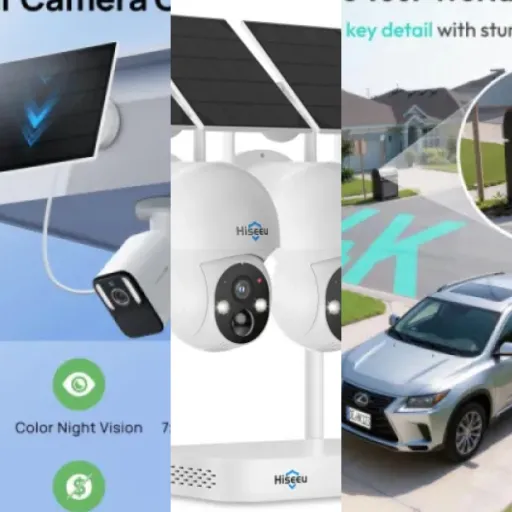
In daily use, the system is pretty straightforward: a base plugged into the router, four wireless cameras powered by solar, and everything controlled through the app. The big promises are no subscription, local storage, solar power, and 360° auto tracking. On paper it ticks a lot of boxes: 5MP resolution, color night vision, 2.4G and 5G Wi‑Fi compatibility, IP66 weather resistance. It sounds like one of those products that tries to do everything at once.
In practice, it’s mostly solid, but not flawless. There are some things it does really well, like ease of installation and picture quality for the price. And there are a few annoying details that you only notice after a week or two: limitations on how many cameras you can add, some quirks in the app, and the fact that you’re basically stuck using your phone or tablet to view everything. Nothing that makes it useless, but enough to be aware of before buying.
If you just want something that records movement around the house, sends phone alerts and doesn’t make you pay a monthly fee, it gets the job done. If you’re expecting a pro‑level CCTV system with advanced zone controls, desktop software and unlimited expansion, this is not it. Think of it more as a decent, self‑contained home kit for people who want a mix of simplicity and flexibility, without going deep into networking or drilling half the house.
Price vs what you actually get: good deal with a few trade‑offs
For a 4‑camera kit with a base station, solar panels, and local storage, the SOLIOM SH502 sits in a pretty fair price range compared to big brands. If you price out four individual wireless solar cameras from some well‑known names plus a hub or subscription, you often end up paying more over a couple of years. Here, you pay once and that’s it: no monthly fees, no cloud subscription required to access recordings. For people who hate ongoing costs, that alone is a big plus.
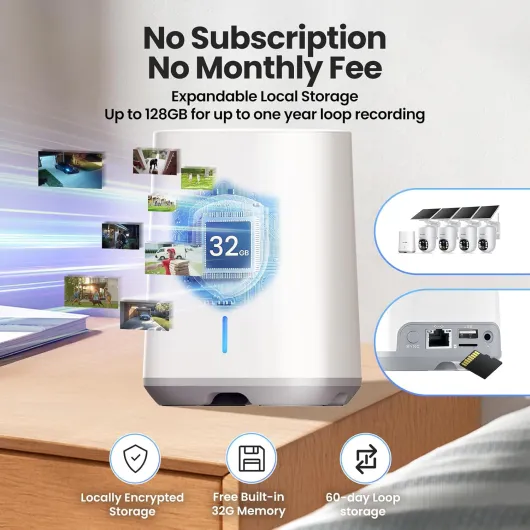
The value for money feels good mainly because you get several features bundled together: 5MP video, PTZ with auto tracking, color night vision, two‑way audio, IP66 weatherproofing, and a base with encrypted local storage. The 32 GB card they include is not huge, but it’s enough for around two months of loop recording according to the brand, and you can upgrade to 128 GB if you want more history. The fact that the footage stays on your own device and not on some remote server is also a plus if you’re a bit paranoid about privacy.
That said, there are some limitations that come with the price. You’re capped at 4 cameras per base; if you want more coverage later, you need another base, which means more cost and more complexity. There’s no official way to view the cameras on a dedicated monitor or TV, unless you start using workarounds via emulators or casting from your phone. Motion zones are basic – you don’t have fine control like on some pricier systems, so you may spend time adjusting angles to avoid constant alerts from traffic.
So overall, I’d say the SH502 is good value if your goal is: “I want up to four wireless cameras around my house, I’m okay with using just my phone or tablet, and I don’t want to pay subscriptions.” If you’re planning a bigger, more expandable setup with integration into other systems, or you absolutely need a PC client or NVR output, then you might be better off saving up for a more advanced system and treating this one as more of a mid‑range, self‑contained solution.

Design and installation: not pretty, but practical
The cameras themselves are classic bullet style with a dome‑like PTZ head, made from ABS plastic. They’re not going to win any design awards, but they look like what they are: outdoor security cameras. Personally, I don’t care if they look fancy; I almost prefer them to be obvious so people see they’re being filmed. Size‑wise, they’re not tiny, especially once you add the antenna and solar panel, but they’re not huge floodlight monsters either. Mounted under the eaves, they blend in enough that I don’t notice them day‑to‑day.
Installation is fairly straightforward: you screw the bracket into the wall or fascia, clip the camera on, then decide where to put the solar panel. The 10 ft cable on the panel gives you some freedom. On one camera, I put the panel a couple of feet above the unit to catch more light, and that did help the battery percentage stay higher. The mounts are basic but do the job. You can angle the camera and lock it in place with a simple screw. It’s not super precise like some ball‑joint mounts, but once you find the right angle, you don’t touch it again.
Controls are all through the app, so there are no physical buttons to worry about apart from the power connection and reset if needed. The PTZ rotation is smooth enough when you swipe around in the app, though there’s a slight delay between your finger movement and the camera response. Nothing dramatic, just don’t expect instant gaming‑level response. The auto‑tracking makes the camera move on its own when it detects a person, which can look a bit weird at first, but you get used to it.
From a design point of view, my only real complaint is cable management. Each camera ends up with a power lead to the solar panel and an antenna sticking out, so if you’re picky about clean lines, you’ll be spending time tucking cables under trims or using clips. It’s not messy, it’s just not super sleek. But for a DIY setup, I’d say the design is practical and clear, more focused on function than looks, which suits this kind of product.
Solar power and battery life: works, but sun still matters
The big selling point here is solar power. Each camera has an internal battery (3.7 V, 18.5 mAh is what’s listed, but in practice it behaves like a normal small lithium pack) and the panel keeps it topped up. When you first install them, you really do need to fully charge the cameras by cable before putting them outside. I skipped that on one unit and it struggled the first two days until it caught up on solar. Once I actually followed the instructions and pre‑charged, things went much smoother.
In my setup, with moderate traffic (a few motion events per hour during the day, fewer at night), the batteries have stayed between 60–100% depending on how much sun we got. On a sunny week, they basically sit near full all the time. On a cloudy, rainy week, they drop more, but not to a scary level. The upgraded charging circuit they talk about seems to do the job: it doesn’t need full blazing sun all day to keep up, but if the panel is in permanent shade, don’t expect miracles. Placement of the solar panel matters more than people think – I had to move one panel higher after seeing that camera drop into the 40% range.
The 60‑second clip limit per event is clearly there to protect the battery. If the camera recorded continuously every time something moved, the battery would die quickly, especially in winter. For most home uses, 60 seconds is enough to see who came to the door or what happened in the driveway. But if you’re watching a long delivery or someone hanging around, the camera may record several clips back‑to‑back instead of one long one. It’s not ideal for very detailed timelines, but it’s a fair compromise for a solar system.
Overall, I’d say the solar + battery combo is reliable as long as you’re realistic. If you live somewhere with very poor light for weeks and you point the panels badly, you’ll run into issues. If you take 10 extra minutes to think about sun exposure and pre‑charge the units before mounting, they just quietly run in the background. I haven’t had to climb a ladder to manually charge them since the initial install, which is exactly what I wanted from a setup like this.
Build quality and weather resistance over time
The cameras are rated IP66, which basically means they can handle heavy rain and dust without complaining. Mine have already been through a couple of solid downpours and some windy days, and so far there’s been no sign of water ingress, fogging inside the lens, or random shutdowns. The ABS plastic doesn’t feel premium in the hand, but once it’s on the wall you stop caring. It’s rigid enough, doesn’t flex much, and the joints for the PTZ head feel tight, not wobbly.
Temperature‑wise, I’ve only had them in mild conditions so far (roughly 5–25°C), and they behaved normally. No weird reboots or battery percentage swings. I can’t speak yet for very harsh winters or heatwaves, but given the sealed design and low power draw, I’d expect them to cope as well as any other consumer outdoor camera in this price bracket. The antennas are fixed but sturdy; I accidentally bumped one with a ladder and it didn’t snap or loosen, which reassured me a bit.
The mounting hardware is basic zinc‑type screws and wall plugs. Not junk, but if you’re putting these into anything more serious than brick or wood (like very hard concrete), you might want to use your own fixings. Once mounted, the cameras haven’t moved in strong wind. No drooping or drifting away from the original angle, which is something I’ve seen on cheaper mounts. The solar panels also stayed in place and didn’t rattle, even though they’re more exposed.
In terms of long‑term durability, the main question mark for me is the battery. All lithium batteries degrade over time, especially in outdoor temperature swings. The good point here is that the battery is constantly being trickle‑charged by solar, so it’s not going through deep discharge cycles all the time. That should help. But realistically, in 2–3 years, you might see some drop in how well they hold charge, like with any cordless device. For the price, and considering everything is sealed and weather‑resistant, I’d say the durability is respectable, but I wouldn’t expect it to last a decade without any drop in performance.
Video quality, motion tracking and alerts in real life
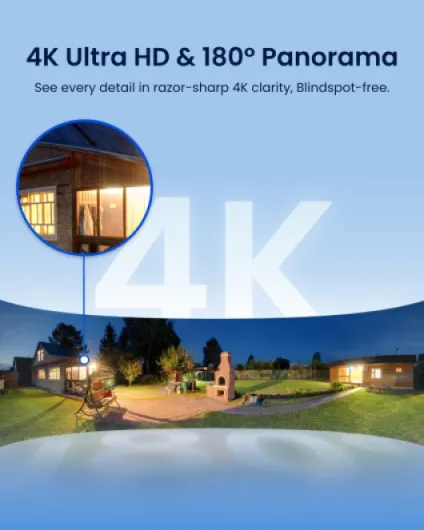
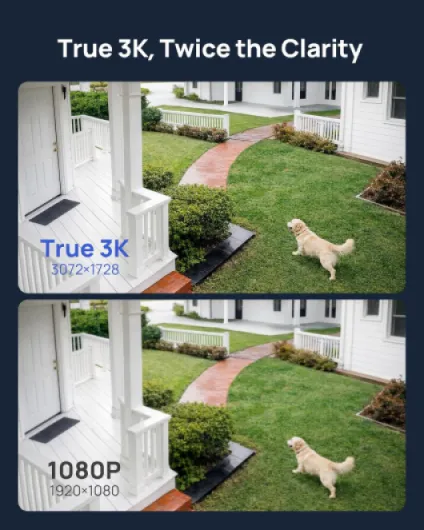
On paper, the cameras are 5MP / 3K and that lines up pretty well with what you see in the app. Daytime image quality is genuinely decent: faces, number plates within reasonable distance, and details like clothing are clear. It’s not cinema‑grade, but for a home kit at this price, I was happy. The frame rate is 15 fps, so movements aren’t ultra‑smooth like a 60 fps stream, but you can easily see what’s going on. H.265 compression helps keep the file sizes under control without making the picture look like a blocky mess.
At night, the color night vision with the built‑in LEDs is useful if you enable the light. If you leave the LEDs off, you get the usual black‑and‑white infrared look. With the light on, you can still see colors on clothes, cars and so on, but obviously it’s not full daylight. The advertised night vision range is around 19 feet, and that matches my tests: beyond that, you still see shapes, but details drop fast. If you want to clearly see faces at longer distances, you’ll need extra lighting in the area, no way around it.
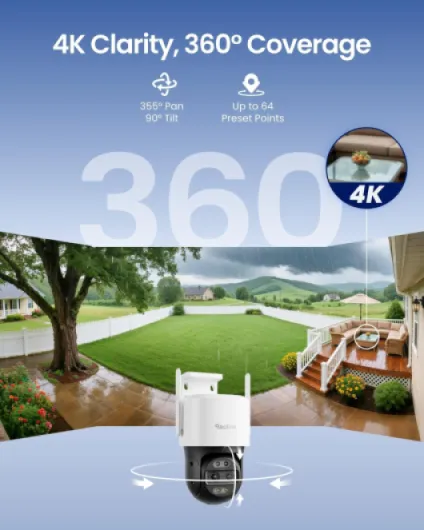
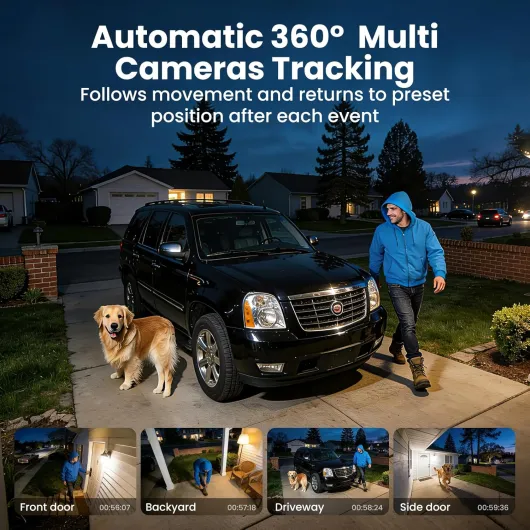
The 360° auto human motion tracking works better than I expected. When someone walks into frame, the camera follows them as they move, panning and tilting. It’s not perfect – sometimes it overshoots a bit or takes a second to catch up – but most of the time it keeps the person in the center of the frame. The base can also coordinate multiple cameras, so if you walk from one zone to another, the next camera picks you up. It’s not some sci‑fi tracking system, but for a home kit, it’s pretty solid. The only catch is that moving the lens around a lot probably costs a bit of battery.
Notifications to the phone are almost instant most of the time. I’d say there’s usually a delay of 1–3 seconds from movement to alert when I’m on Wi‑Fi, and maybe a bit more on mobile data. One Amazon reviewer mentioned occasional lag, and I saw that too, especially when my home internet was under load. The motion detection itself is fairly smart; I didn’t get spammed by every leaf moving, but you still have to tweak the sensitivity. There’s no advanced per‑zone masking, so if your camera faces a busy road, expect some trial and error with angles to avoid constant triggers.
What you actually get in the box and how it works
The kit is basically built around a central base (Soliom Base) and four wireless cameras. The base plugs into your router with the included Ethernet cable and holds the local storage (32 GB microSD pre‑installed, upgradable to 128 GB). All recordings are saved there, not in the cameras. That’s good because if someone nicks a camera, the footage is still on the base inside your house. Setup was honestly simple: plug in the base, open the app, and the cameras were already paired out of the box. No QR code circus, no weird Wi‑Fi dance.
Each camera has its own detachable solar panel with a 10 ft cable. You can mount the panel straight above the camera or move it to where the sun actually hits. That flexibility matters more than you’d think. On my north‑facing wall, the camera sits in the shade but the panel is up higher catching light. The cameras connect wirelessly to the base, and the base connects to your home network (2.4G or 5G). Despite the spec sheet saying “cellular”, it’s really just Wi‑Fi + Ethernet, no SIM card here.
Function‑wise, every camera has pan/tilt (PTZ) with auto human motion tracking, a built‑in light for color night vision, a microphone and speaker for two‑way audio, and 5MP video recording in H.265. The app lets you see live view, scroll through recordings, tweak motion sensitivity, turn lights on/off, and talk through the camera. Clips are limited to about 60 seconds per event, which is a trade‑off to save battery since these are solar powered.
Overall, the system feels like a closed, self‑contained ecosystem: everything goes through the Soliom Base and app. There’s no integration with a regular NVR, no direct HDMI output, no official PC software. For some people that’s fine because it stays simple. For others who like to tinker or want a big wall monitor, it’s a limitation. But as a simple 4‑cam kit with local storage and no subscriptions, the concept is pretty clear and easy to get your head around.
Pros
- Easy installation with pre‑paired cameras and simple app setup
- Solar power works well and avoids running power cables everywhere
- Local encrypted storage on the base with no subscription or cloud fees
Cons
- Limited to 4 cameras per base, no simple expansion beyond that
- No official desktop/monitor viewing; mostly phone/tablet only
- Motion zones and clip length are basic compared to more advanced systems
Conclusion
Editor's rating
After using the SOLIOM SH502 for a while, my take is pretty simple: it does what it promises, with a few rough edges. You get four solar‑powered cameras, a base with local encrypted storage, 5MP video, auto tracking and color night vision, all without paying a monthly fee. Setup is genuinely easy, notifications are generally quick, and the image quality is good enough for normal home security use. For the price bracket it sits in, that’s a solid package.
It’s not perfect though. You’re limited to four cameras per base, there’s no official desktop or TV viewing, and the motion detection tools aren’t as advanced as some higher‑end systems. The 60‑second clip limit can be a bit restrictive if you want continuous recording of longer events, and you do need to think about solar panel placement to keep the batteries healthy, especially in darker months. The app is usable but has a few small quirks that you only notice after daily use.
If you’re a homeowner or small business owner who wants simple, wire‑free outdoor coverage with no ongoing costs, this kit makes sense and feels like good value. If you’re a power user who wants deep integration, complex motion zones, PC software, or a big multi‑monitor control room, this system will feel too limited. In short: pretty solid for a straightforward, subscription‑free setup, as long as you accept its boundaries and don’t expect a full professional CCTV platform for this price.