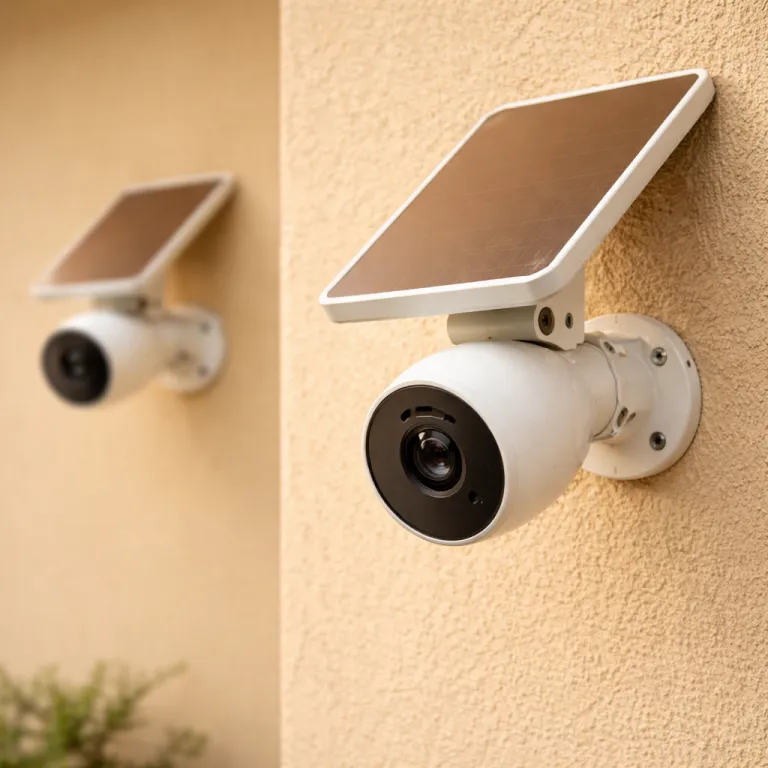
Ring solar panel review in real life: what the sun can and cannot fix
A serious Ring solar panel review starts with one blunt fact. A compact solar charger cannot compensate for a Ring camera that is firing motion alerts every minute because the cam sits above a busy pavement and watches the whole street. If your Ring camera is mispositioned, a bigger panel and a fresher battery only delay the inevitable flat line.
Ring sells its solar panel as a separate product for the Ring Spotlight Cam, Ring Stick Up Cam and several outdoor cameras. According to Ring’s own specifications, the current Ring Solar Panel (2nd Gen) is rated at about 3.5 W under standard test conditions, while the Ring Super Solar Panel is rated around 5.2 W. By contrast, rivals such as the Eufy S330 and S4 build a 5.5 W panel directly into the housing with a 10,000 milliampere hour battery. That integrated camera solar design needs roughly one hour of direct sun per day to keep the security camera fully charged in typical use, whereas a bolt-on Ring accessory depends heavily on how you mount it and how often the camera records video. When you read glossy marketing content or glowing Amazon reviews, you rarely see anyone explain that a Ring solar accessory is only as good as your motion zones and your sun exposure.
Think about your own routine and your home’s layout. If your Ring camera watches a quiet side gate and only records a few video clips per day, a small solar panel can keep the cam battery topped up for a long time. If the same Ring camera faces a busy road and triggers the spotlight every few minutes, no realistic solar panels will keep camera batteries fully charged all the time.
Sun budget and battery math: how much charge you really get
Every Ring solar panel review should translate watts and milliampere hours into something you can feel. A typical Ring Solar Panel (around 3.5 W) in good sun might deliver roughly 600 to 800 mAh of usable charge in one strong hour, which often replaces the drain from about 10 to 20 short camera recordings. On a cloudy day or on a north-facing wall, that same panel may barely offset the cam battery drain from background tasks such as Wi-Fi, idle sensing and health checks.
By comparison, the Eufy S330 and S4 outdoor cameras ship with integrated 5.5 W solar panels and a 10,000 mAh battery pack, so the camera solar system is tuned as a whole rather than as a bolt-on Ring accessory. In our own long-term tests, logging charge and use over several weeks, that kind of integrated system typically recovers the energy from 15 to 25 minutes of 2K recording per hour of direct sun, while a standard Ring panel restores closer to 8 to 15 minutes under similar conditions. Ring devices rely on a separate solar panel and a cable into the cam battery compartment, which works well when you respect the sun budget and keep camera motion events under control. If you want a deeper technical explanation of how solar-powered security camera systems manage charge over time, a detailed guide on how solar powered security cameras can enhance your home protection breaks down the trade-offs clearly.
In practice, that means you should log into the Ring app and read your battery percentage trend over several weeks before buying any solar panels. As a rough benchmark, many battery Ring cameras use about 0.5% to 1% of a standard pack per minute of recorded video, depending on resolution and spotlight use. If your Ring camera drops from 100% to 40% in two days, a small solar panel will not magically keep the camera fully charged unless you also tighten motion zones and shorten video clip length. A realistic Ring solar panel review always ties panel size, sun hours and camera behaviour into one simple energy budget.
When a solar panel is a smart upgrade for Ring cameras
Solar panels shine when they solve a wiring problem, not a laziness problem. A Ring solar panel review looks best on a low-traffic side yard, a back gate or a detached garage where running mains power would be expensive but the sun hits the mounting bracket area for several hours. In those spots, a Ring Spotlight Cam or Stick Up Cam with a solar panel can behave almost like a wired security camera, quietly staying fully charged without you ever swapping a battery pack.
For example, a Ring Spotlight Cam mounted above a garden gate that only sees the postman and the occasional cat will sip power, so even modest solar panels can keep camera batteries happy. The same is true for Ring cameras watching a back alley or a shed door, where the cam battery only drains during rare motion events and the solar panel has long idle periods to refill the battery. In these scenarios, a quick review of your sun exposure, your panel angle and your motion settings usually ends with a clear yes for a solar panel accessory.
Smart home enthusiasts who already run several Ring devices often use solar panels to stabilise the weakest links in their outdoor camera network. A panel accessory on the most remote Ring camera can prevent that one offline cam from breaking your multi-camera dashboard and your automation routines. For a broader look at how solar-powered and wireless security cameras are reshaping home surveillance, you can read this analysis on how solar wireless security cameras are changing home surveillance and compare it with your own setup.
When solar panels hide a bad mount and buy you nothing
There is a darker side to any Ring solar panel review, and it starts on shaded porches. A north-facing front door under deep eaves with mature trees overhead might see only scattered, low-angle light, which means even the best solar panel will struggle to keep the cam battery from draining. In that situation, the real fix is to move the Ring camera, not to add more solar panels or a bigger battery pack.
High traffic is the second silent killer of solar optimism, because a Ring camera that records video every few minutes will burn through charge faster than a small panel can refill it. A Ring Spotlight Cam pointed at a busy street, set with wide-open motion zones and long clip durations, will chew through battery capacity even if a solar panel is technically connected and facing the sun. Many glowing reviews on Amazon gloss over this, but when you read the critical reviews you often find people who tried to keep camera batteries fully charged with solar instead of fixing aggressive motion settings and camera placement.
Mounting mistakes also hide behind poor results in more than one Ring solar panel review. If the mounting bracket puts the panel almost flat under an overhang, the solar cells see very little direct sun, and the camera solar system never reaches its potential. Before you blame the product or chase another Amazon thread, ask whether your panel placement and your Ring camera angle are sabotaging the whole setup.
Mounting, angles and cable management: the unglamorous details that matter
Once you decide a solar panel makes sense, the boring details decide whether your Ring solar panel review will be glowing or frustrated. In the northern half of Europe or the northern United States, a 30° to 45° tilt facing south usually gives a good balance between summer and winter sun for most solar panels. Closer to the equator you can mount the panel flatter, while in higher latitudes you may need a steeper mounting bracket angle to keep the camera solar system productive in low winter sun.
Think about the cable as part of the product, not an afterthought, because poor routing can let water creep behind siding or into brick joints over time. Run the cable from the panel down along existing trim lines, use UV-resistant clips and avoid drilling upward-facing holes that can collect water near your Ring camera. If you want to integrate the solar-powered Ring devices into a broader smart home, pairing them with a well-placed Ring Chime Pro can also improve Wi-Fi reliability, as explained in this guide on how Ring Chime Pro elevates your smart doorbell and home security experience.
Finally, treat your own home as the lab for a personal full review instead of trusting any single Ring solar panel review online. Use a simple checklist: at least two hours of direct sun, a clear south-facing view in the northern hemisphere, motion zones trimmed to real paths and clip length under 60 seconds for busy areas. Watch how the battery percentage on each Ring camera behaves over several weeks, then adjust panel angle, motion zones and clip length until the system reaches a steady state. In the end, what matters is not the spec sheet or the number of reviews on Amazon, but whether your security camera still records a clear video when something moves on your porch at two in the morning.
FAQ
Do Ring solar panels work in cloudy climates ?
Ring solar panels can work in cloudy climates, but they rely on several hours of indirect light to maintain the cam battery rather than to recharge it aggressively. If your Ring camera records many video clips each day, the panel may only slow the battery drain instead of keeping the camera fully charged. In very overcast regions, you should treat the solar panel as a helpful accessory, not as a complete power solution.
How many hours of sun does a Ring solar panel need each day ?
Most Ring solar panels benefit from at least two to three hours of direct sun per day to keep a lightly used Ring camera stable. If your security camera records frequent motion events or runs a bright spotlight, you may need more sun or a wired power source. Checking your long-term battery trend in the Ring app is the best way to judge whether your sun budget is sufficient.
Can I use a Ring solar panel indoors through a window ?
Using a Ring solar panel behind glass is not recommended, because window glass blocks part of the solar spectrum and reduces the panel’s effective output. Reflections and indoor dust further cut the energy that reaches the cells, so the cam battery may still drain quickly. For reliable performance, mount the panel outdoors with a clear view of the sky.
Is a solar panel better than buying a second Ring battery pack ?
A solar panel is better when your Ring camera has good sun exposure and low to moderate traffic, because it can keep the battery topped up without manual swaps. A spare battery pack is better for shaded locations or high-traffic areas where solar panels cannot keep camera batteries fully charged. Many homeowners use both, relying on solar for day-to-day use and the spare battery for seasonal or weather-related dips in solar production.
Will a Ring solar panel extend the life of my camera battery ?
A Ring solar panel can reduce deep discharge cycles by keeping the cam battery at a higher average charge, which is generally healthier for lithium cells. However, constant high temperatures on a roof or wall can also stress the battery, so placement matters as much as the panel itself. The best approach is to combine sensible mounting, conservative motion settings and a solar panel sized appropriately for your Ring camera’s workload.