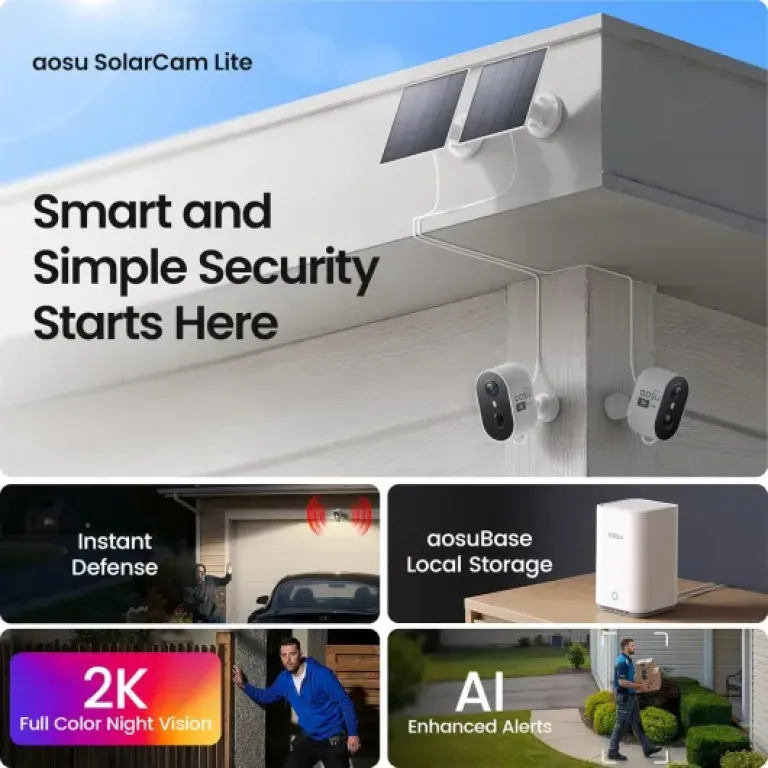

Summary
Editor's rating
Value for money: fair price if you actually use all four cameras and local storage
Design and build: practical, a bit chunky, but weatherproof
Battery and solar: mostly hands‑off, as long as the panels see real sun
Build quality and long-term feel: decent plastics, no drama so far
Video quality, detection, and app: good overall, with some software quirks
What you actually get in this aosu 4‑cam solar kit
Pros
- Four 2K wireless cameras with separate solar panels and local storage in one package
- No mandatory subscription; 32 GB built-in storage plus microSD expansion up to 1 TB
- Good daytime and color night vision quality with useful PIR + AI human detection
Cons
- App and software are functional but a bit rough, with limited alarm sound customization
- Base station requires wired LAN and solar panels need decent sun exposure to fully shine

Specifications
View full product page →| Brand | aosu |
A 4-camera solar kit that actually keeps things simple
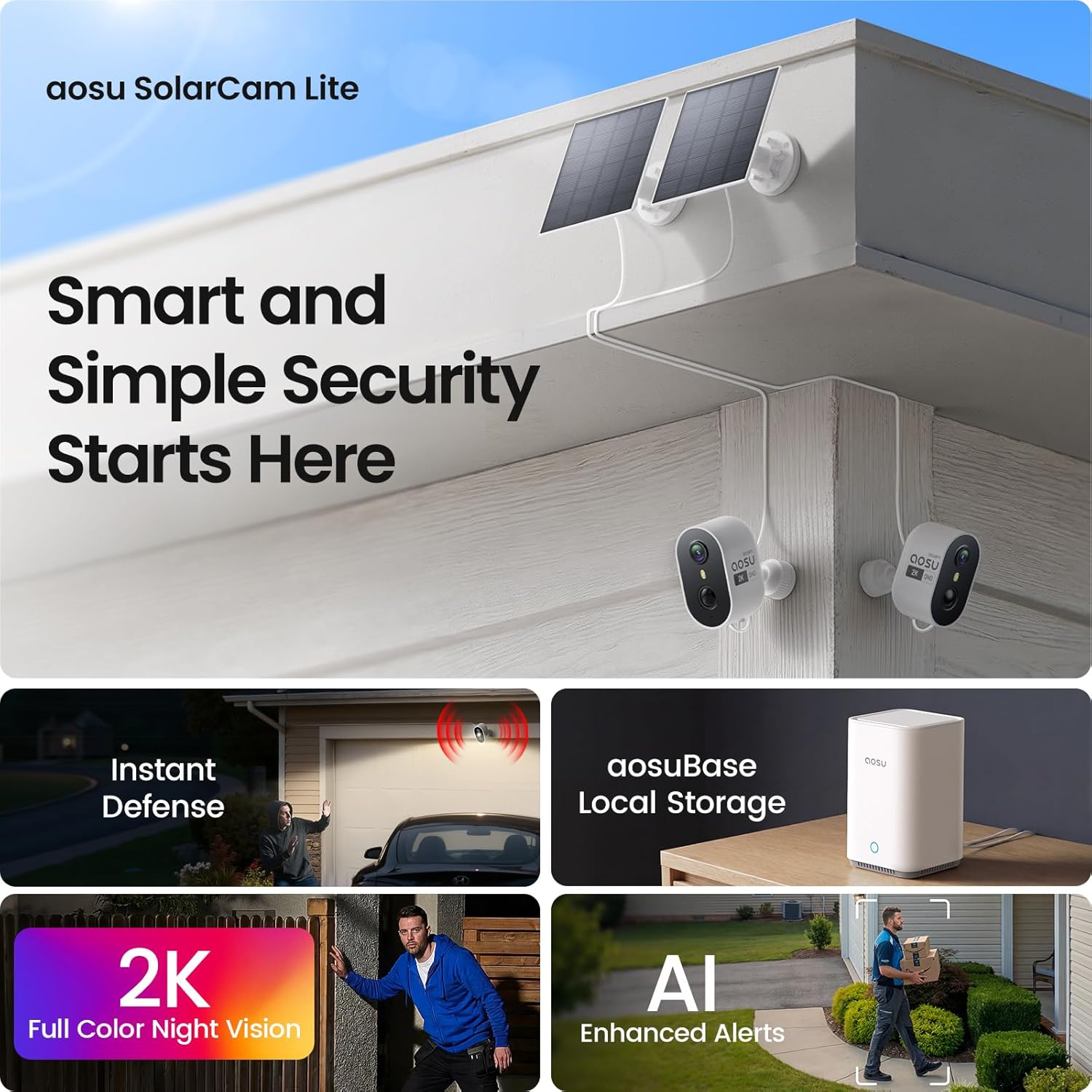
I set up this aosu 2K solar 4‑camera kit at home and partly at a small garage I rent, and I’ve been using it long enough to see the good and the annoying parts. I’ve used other wireless systems before (Eufy, TP‑Link Tapo), so I wasn’t going in blind. My goal was clear: cover the driveway, the front door, the backyard, and the garage gate without having to change batteries every month or pay a subscription. On paper, this kit checks all those boxes: 4 cameras, solar panels, local storage on the aosuBase 2.0, and no forced cloud plan.
First impression: it doesn’t feel like cheap junk, but it also doesn’t feel like premium pro gear. It’s somewhere in the middle, which is fine for home use. The install was mostly straightforward, the app is decent, and the video quality in 2K is good enough to see faces and number plates at short distance. The big selling point for me was the solar + local storage combo. I’m tired of climbing ladders to recharge cameras and I don’t want to pay monthly fees just to see who walked past my door.
In daily use, the system does what it’s supposed to do: it records people coming and going, sends notifications, and lets me check live view quickly. The AI human detection is not perfect but clearly better than pure motion detection; I got fewer alerts for tree branches than with my old cameras. The multi‑camera view in the app is also handy when you want to quickly scan the property. It’s not ultra polished, but it works.
It’s not all positive though. The software still feels a bit rough at the edges. Some options are buried in menus, the alarm sound is a bit annoying and you can’t really customize it much, and the first firmware update took ages. Also, the base station needs a wired LAN connection, which is fine for me but can be a pain if your router is in a weird spot. Overall, I’d say it’s a pretty solid mid‑range system for people who want solar and local storage, but it’s not perfect and there are small software quirks you have to accept.
Value for money: fair price if you actually use all four cameras and local storage
Price‑wise, this aosu 4‑camera solar kit sits in that mid‑range zone where you expect things to work well but not be perfect. If you compare it to buying four individual cameras from some big brands plus a separate base or NVR, you often end up paying more, especially once you add cloud subscriptions. Here, the big value point is that you get: 4 cameras, 4 solar panels, and a base with 32 GB built‑in and room for a 1 TB microSD, and you’re not forced into a monthly fee.
If you’re actually going to use all four cameras (for a house with several sides, a driveway, and a backyard, or a small club/sports area like one reviewer did), then the price starts to make sense. You cover multiple angles in one shot, all managed from one app. The local storage means that over time, you save on what you’d otherwise pay for cloud. If you’re planning to keep a system like this for several years, that adds up.
Where the value is a bit less clear is if you only need one or two cameras. In that case, a smaller kit or a couple of standalone cameras from other brands might be cheaper. Also, the software, while functional, is not the best in class. One German reviewer even said “Geht so” about the software, and I agree: it works, but it could be smoother and offer more customization, especially for the alarm tone and some notification behavior. So part of what you’re paying for here is the convenience of an all‑in‑one package, not a perfectly polished app.
Overall, I’d say the value for money is good, not mind‑blowing. If you want solar, wireless, local storage, and four cameras in one go, this is a sensible option. If you only care about the absolute lowest price and you’re fine with plugging cameras into power outlets or paying a cheap cloud fee, you might find cheaper setups. But for people like me who want to avoid subscriptions and avoid climbing ladders to recharge, the balance between price, features, and real‑world use is pretty reasonable.
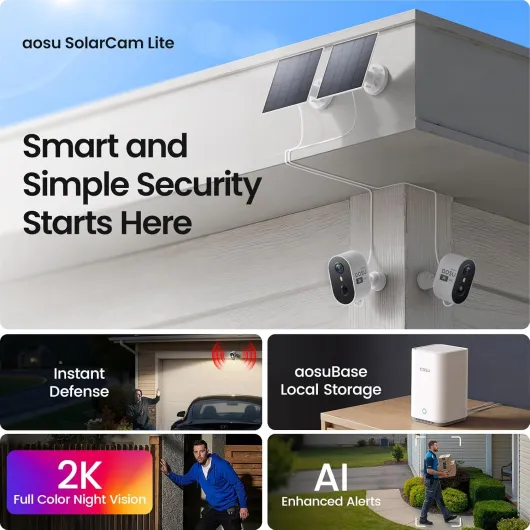
Design and build: practical, a bit chunky, but weatherproof
The design is pretty classic for bullet‑style cameras: white body, black front, nothing fancy. Each camera is a small rectangular block with a ball‑joint mount. At first, I didn’t even realize how the ball joint worked and I was scared to force it, same as one of the German reviewers said. You actually have to twist the plastic with a bit of confidence; once you do, you see that you can adjust the angle quite precisely. The mount is stiff in a good way: you set it once and it doesn’t sag over time, even with some wind and rain.
The split solar panel design is one of the better design choices here. The panel connects via a cable (around 3 m) to the camera, so you can mount the camera under an eave or in the shade and place the panel higher or further where the sun actually hits. On my garage, the wall is in the shade most of the day, but the roof edge gets light; the panel still charges, even if slowly. It’s not a giant panel, so don’t expect miracles in deep winter, but for normal conditions it does the job and keeps the battery topped up.
The base station is quite compact and discreet. It’s not something you’ll show off, but it doesn’t take much space near the router. There are no crazy blinking lights, just basic indicators. It feels like standard plastic, decent but nothing special. Overall, the cameras and panels look fine on the house. They’re visible enough to act as a deterrent, but not so big that they ruin the facade. If you’re picky about aesthetics, they’re neutral enough to blend in on most walls.
In terms of weather resistance, they’re rated IP65, and so far they’ve seen rain and some cold nights without any problem. No fogging inside the lens, no water ingress. I didn’t baby them at all. For the price range, I’d call the design practical rather than pretty. It’s clearly focused on function: simple mounts, easy wall installation, panels that you can angle, and a form factor that works for typical house corners and eaves. If you want sleek, ultra‑compact cameras, this is not that, but it’s fine for a straightforward security setup.
Battery and solar: mostly hands‑off, as long as the panels see real sun
The big promise of this kit is long battery life with solar top‑up, and overall it delivers, as long as you’re not installing everything in permanent shade. aosu claims up to 120 days of battery life, which is obviously in ideal conditions and low activity. In real life, with the solar panels connected, I basically don’t worry about the battery on three out of the four cameras. They sit between 80–100% most of the time, even with daily motion events. Only the one with very limited sun sometimes dips lower, but still doesn’t reach a critical point.
What I like is that the cameras arrive with some charge already, so you can set everything up without plugging in cables right away. After installation, the solar panels take over. On a couple of cloudy days, I saw the battery drop slightly, but once the sun came back, it climbed again. The panels are small, so if you put the camera under an eave facing north and the panel also in the shade, don’t expect miracles. You really have to think a bit about where to place the panels, but that’s true for any solar camera.
Charging speed is not crazy fast, but that’s not the point. The idea is more “maintain the charge over time” than “charge from 0 to 100 in one day”. As one German reviewer said, even at a “critical” location with limited sun, the panel still charged slowly but steadily. That matches what I saw: in winter or bad weather, the battery will go down slowly, but in normal conditions it stabilizes. For a typical home setup with cameras on the sides of the house or on a garage, it’s more than enough to forget about ladders and charging cables.
For me, the main advantage is the mental comfort: I’m not constantly checking battery percentages or planning recharges. The app shows the battery level clearly, and with the right panel placement, it just stays in the safe zone. If you have very high traffic areas with tons of recordings every day, or if your house is in a spot with very little direct sun, you might need to watch it more closely. But for a normal suburban house or small business with half‑decent sun exposure, the solar + battery combo here is practical and reliable enough.
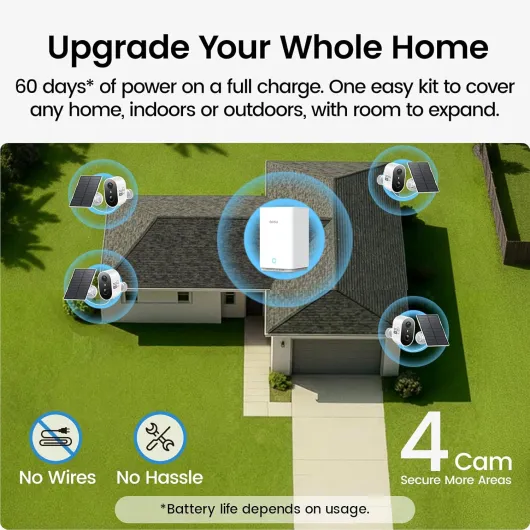
Build quality and long-term feel: decent plastics, no drama so far
In terms of build quality, the aosu kit feels like solid mid‑range gear. The cameras and solar panels are made of standard hard plastic, nothing fancy, but they don’t feel flimsy. The mounts in particular are reassuring: the ball joint is tight, the screws bite well into the wall plugs, and once everything is fixed, there’s no wobble. I’ve had one camera quite exposed to wind and rain on a corner of the house, and it hasn’t moved or loosened up.
The IP65 waterproof rating seems justified. I’ve had rain hitting the lens directly, plus some light frost at night, and there’s been no condensation inside the camera or visible damage. The solar panels also hold up fine; they’re not huge glass slabs, more like compact, slightly textured surfaces that don’t scratch easily. I gave one a quick wipe with a cloth after a dusty week, and it cleaned up without a problem.
What I can’t fully judge yet is multi‑year durability, but I’ve seen one Amazon user saying they already had aosu products before and trusted the brand enough to buy again. That’s a good sign, but obviously not a guarantee. Compared to cheaper no‑name AliExpress cameras I’ve tried in the past, this feels more robust. It’s still not on the same level as very high‑end wired systems, but for a wireless solar kit at this price, the materials and assembly seem honest.
One thing to note: the cables for the solar panels are fairly thin, so if you install them where people can easily grab or snag them, you’ll want to secure them properly with clips or conduits. They’re not going to survive someone yanking them hard. For a normal install along a wall or under a roof edge, though, they’re fine. Overall, I’d rate durability as good enough for everyday outdoor use: you can mount it and forget it, as long as you don’t expect it to survive vandalism or extreme conditions like a coastal storm every week.
Video quality, detection, and app: good overall, with some software quirks
On the video side, the 2K / 3 MP resolution is solid for this kind of system. During the day, the image is sharp enough to clearly see faces at typical distances (3–7 meters) and read number plates if the car is not moving too fast and not too far. Colors are correct, not super vibrant, but for security that’s not what matters. At night, with the color night vision on, the cameras use a spotlight to keep the image in color. It’s actually pretty useful: you can see the color of clothes, cars, etc. If you don’t want the light on, you can switch to classic infrared black‑and‑white mode, which is less visible from the outside.
For motion and AI detection, it’s a mix of good and “okay”. The PIR sensor does a better job than pure pixel‑based detection for ignoring small motions in the background. The AI human detection works decently; most of the time, it correctly triggers on people and not on cars far away or tree shadows. That said, it’s not perfect: I still got a few random alerts, especially when the sun changed quickly or when a big cat walked right in front of the camera. You can tweak sensitivity and set activity zones in the app, which helps a lot if you take the time to fine‑tune it.
The app performance is where you feel that it’s good, but not polished like some bigger brands. The initial setup is actually very easy; the app walks you through pairing the base and cameras, and I had all 4 online in under 10 minutes. The multi‑view screen with all cameras at once is very handy. Playback is acceptable, but sometimes the timeline takes a second to load, especially if your Wi‑Fi is busy. The camera‑to‑camera tracking is a real plus when an event moves across different spots; you don’t have to open four different clips manually.
On the downside, the software still has some rough edges. One Amazon user mentioned the alarm sound being annoying and not changeable, and I agree. It’s loud and a bit harsh, and you don’t have many customization options. The notification settings also take a bit of trial and error to get right. Nothing is broken, but you feel like with a couple of app updates, the experience could be smoother. In everyday use, though, the system does what you need: it records, it notifies, and you can quickly review what happened without pulling your hair out.
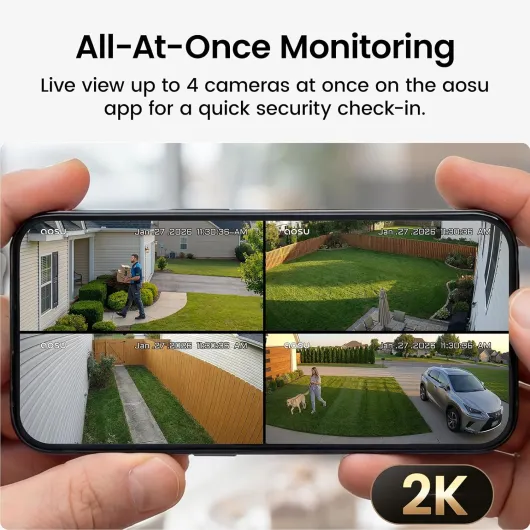
What you actually get in this aosu 4‑cam solar kit
This kit is basically a full starter system: you get 4 wireless outdoor cameras, each with its own small separate solar panel, plus the aosuBase 2.0 which acts as the hub and local storage. The base comes with 32 GB built‑in, and you can add a microSD card up to 1 TB if you want to keep more history. Everything connects over Wi‑Fi (2.4 and 5 GHz) but the base itself plugs into your router via Ethernet. So it’s not fully wireless in that sense; the cameras are, the base is not.
The cameras record in 2K / 3 MP, with color night vision thanks to built‑in LEDs. There’s two‑way audio, and a small extra: voice modification if you want to mask your real voice. I tried it; it works, but it’s more of a gimmick for me. The system has PIR + AI detection, which means it uses a heat‑based sensor to detect motion and then tries to identify humans. In practice, it cuts down on useless alerts compared to basic motion detection, but you’ll still get the odd false alarm from strong light changes or a cat walking very close.
On the app side, you can see all 4 cameras at once, which is honestly one of the things I liked the most. For a quick check, it’s way better than jumping into each camera separately. There’s also this “camera‑to‑camera tracking” feature: if the same person walks from the driveway to the backyard, the app groups the events in one timeline. It’s not magic, but it does make reviewing events a bit faster and less spammy.
The system is clearly aimed at people who want subscription‑free monitoring. You can still go for cloud options if you want, but it’s not required. For everyday home or small business use (driveways, entrances, small yards, clubhouses, etc.), the feature set is more than enough: local recording, notifications, live view, night color, basic siren + light alarm, Alexa/Google support. If you’re looking for deep smart home integration or super advanced automation, it’s a bit basic, but for straight security use, it gets the job done.
Pros
- Four 2K wireless cameras with separate solar panels and local storage in one package
- No mandatory subscription; 32 GB built-in storage plus microSD expansion up to 1 TB
- Good daytime and color night vision quality with useful PIR + AI human detection
Cons
- App and software are functional but a bit rough, with limited alarm sound customization
- Base station requires wired LAN and solar panels need decent sun exposure to fully shine
Conclusion
Editor's rating
After using the aosu 2K Solar 4‑Cam Kit in real conditions, my conclusion is pretty clear: it’s a solid, no‑nonsense security setup for homes or small businesses that want solar and local storage without getting into monthly fees. The cameras cover a wide area, the 2K image is good enough to identify people, and the color night vision plus PIR + AI detection make daily use practical. The separate solar panels are a real plus; with halfway decent sun exposure, you can basically forget about battery charging.
It’s not perfect. The app is usable but not the best on the market, the alarm sound is a bit annoying and not very customizable, and you need to think about panel placement if your house doesn’t get much direct sun. The base station also needs a wired connection, which can be slightly limiting depending on where your router sits. But the core job—recording events, sending alerts, letting you review what happened quickly—is handled well enough for most people’s needs.
If you want a simple, subscription‑free 4‑camera solar system and you’re okay with a few software quirks, this kit is a good fit. It’s ideal for detached houses, driveways, backyards, or small sports clubs and businesses that need wide coverage. If you’re extremely picky about app polish, or you only need one or two cameras and don’t mind plugging them in, you might want to look at other options. For everyone else, this aosu kit is a pretty solid compromise between price, features, and ease of use.